Get Full Government Meeting Transcripts, Videos, & Alerts Forever!
Get email alerts on the Public Safety Infrastructure topic
No spam. Unsubscribe anytime.
Sanford breaks ground on new $42.5 million public safety facility; Sen. Collins secures $5 million
Summary
City officials and U.S. Sen. Susan Collins marked the groundbreaking for a new Sanford Central Fire and EMS station funded by a voter-approved $42.5 million bond and $5 million in federal congressionally directed spending. Officials said the design emphasizes firefighter health, regional response and a roughly 16-month build timeline.
SANFORD, Maine — City and state officials on Monday gathered to break ground on a new Sanford Central Fire and EMS station funded by a voter-approved $42.5 million bond and $5 million in federal congressionally directed spending secured by U.S. Sen. Susan Collins.
Deputy Mayor Herlihy opened the ceremony, saying he was “born here, local business owner and one of your city council councilors for many years,” and called the project “the foundation of our community’s public safety for decades to come.” He introduced City Manager Steven Buck to summarize a decade of planning that led to the decision to build new stations rather than renovate aging facilities.
Buck said the city began formal reviews in 2014, carried out a 2016 feasibility study and a 2020 follow-up assessment that concluded the existing Springville, Central and South stations were functionally deficient and could not be economically upgraded. “On November 5th, 2024, the voters of Sanford approved the bond for 42.5 million,” Buck said, adding that 14 contractors responded to the bid and Benchmark Construction was chosen to build the project.
Why it matters: Officials said the new facilities are intended to reduce health risks to firefighters, improve response times and support regional mutual aid. Chief Scott Susi cited National Institute for Occupational Safety and Health findings and spelled out how the station’s “hot, warm and cold” zoning, industrial extractors, dedicated decontamination rooms and transition airlocks will limit carcinogen and infectious-disease exposure for crews.
“While a fire station is often seen as just a garage for fire trucks, modern science tells us it’s much more,” Chief Susi said, noting that in 2025 Sanford Fire and EMS responded to over 4,500 incidents, including about 3,400 medical calls. He described living quarters, quiet rooms and private bunker rooms that will support both physical and mental health for staff.
U.S. Sen. Susan Collins, who attended the event, praised the community and said the $5 million she helped secure was part of broader federal support for station upgrades. “This is a visionary project, and it will serve the people of this region for decades to come,” Collins said, and she told the crowd she has worked to advance funding for dozens of local projects statewide.
Robert Frank, senior principal at WBRC Architects and Engineers, described the station as a “risk category four” facility designed to remain operational through severe weather and to provide advanced training spaces and modern apparatus bays. “This building has been designed as a risk category four facility,” Frank said, and he emphasized design choices aimed at reducing harmful exposures from the fire ground.
Tim Somers, vice president of Benchmark Construction, said the company will prioritize safety, quality and minimizing impacts on the surrounding neighborhood. “We will not compromise on safety, quality, or efficiency,” Somers said, adding that the team expects to complete construction and return for a ribbon-cutting in about 16 months.
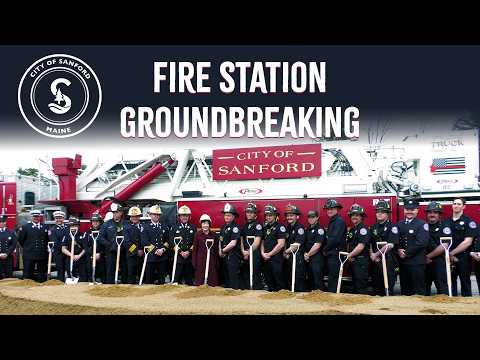
The ceremony concluded with organizers inviting elected officials, project leaders and Sanford Fire and EMS personnel forward for a ceremonial photo and the first shovels in the ground. City officials thanked Senator Collins, the design and construction teams, and the residents whose support carried the bond measure.
Next steps: City staff will move from final design into active construction with Benchmark; officials said a community ribbon-cutting is expected at the completion of construction in roughly 16 months.