Get Full Government Meeting Transcripts, Videos, & Alerts Forever!
Get email alerts on the Traffic Safety topic
No spam. Unsubscribe anytime.
Minnesota Senate committee hears emotional testimony, tough fiscal and technical questions on intelligent speed‑assistance bill
Summary
Senate File 3691, to create an Intelligent Speed Assistance (ISA) program requiring certain repeat or excessive speed offenders to install certified devices, drew emotional survivor testimony and detailed questioning about costs, vendor concentration, device override mechanics, privacy, and implementation. The committee approved an amendment requiring participants to pay fees and tabled the bill for more work.
Senators on March 9 heard prolonged, often emotional testimony and technical questioning on Senate File 3691, a proposal to establish an Intelligent Speed Assistance (ISA) program for repeat and excessive speed offenders.
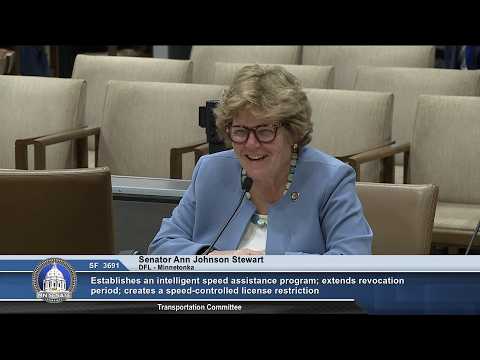
Sponsor Senator Johnson described the bill as a targeted countermeasure for "super speeders," proposing that certain offenders be required to install certified ISA devices on their vehicles as a condition for restricted licenses or license reinstatement. "This technology will save lives," the sponsor said in overview, noting ISA uses location‑based data to recognize speed limits and can prevent a vehicle from accelerating beyond posted limits except under defined override conditions.
Victims' families provided the most direct testimony. Pam Mason, a volunteer with Families for Safe Streets, testified by Zoom about her son Austin, who was left quadriplegic following a hit‑and‑run involving a speeding driver: "This is how my son is now—quadriplegic and nonverbal. The speeding driver never stopped," she said, urging committee members to "hold people accountable" and to adopt tools that prevent future tragedies.
Safety advocates, including representatives from Bicycle Alliance Minnesota and other traffic‑safety organizations, backed the bill as one tool in a broader strategy that also includes street redesign and speed‑limit changes. "This bill will target the worst of the worst and enable technology to prevent these dangerous drivers from hurting and sometimes killing others," a Bicycle Alliance witness said.
Committee members pressed the sponsor and fiscal staff on multiple operational and fiscal issues: the fiscal note estimates first‑year Department of Public Safety (DPS) costs at roughly $423,000 (rulemaking and staffing) and ongoing costs near $519,000 to stand up a Driver and Vehicle Services unit similar to the ignition‑interlock unit; staffing would include several FTEs and a field agent. Senators asked whether participant fees would cover those administrative costs and whether fees and vendor contracts would create vendor concentration. The transcript records senators saying only one vendor is currently operating in Minnesota; the sponsor and DPS said certification and vendor processes would be part of rulemaking and vendor negotiation.
Other concerns included mechanics and safety of an override feature (how and when it would allow temporary acceleration in emergencies), cross‑border operation when a vehicle drives into another state, and data privacy given the device's location tracking. Sponsor Johnson acknowledged some details require technical clarification and said the bill will go to Judiciary and State‑Local committees for further work.
On procedure: the committee approved an amendment indicating program participants must pay a fee to participate, a change intended to help defray administrative costs, and then chose to lay the bill on the table for more committee stops and drafting, including further work on vendor certification, override mechanics, privacy protections and the fee structure.
What happens next: The bill will return for further vetting in committee and will go to Judiciary and State‑Local for additional review before the committee decides whether to move it to the floor.