Get Full Government Meeting Transcripts, Videos, & Alerts Forever!
Get email alerts on the Child Safety topic
No spam. Unsubscribe anytime.
Senate committee debates bill to bar minors from conversational chatbots; authors agree to refine age‑verification and liability language
Summary
Senate File 1857, which would prohibit minors' access to conversational AI chatbots and companions, drew emotional testimony about alleged harms and sharp pushback from industry on breadth and implementation; the committee laid the bill over to refine definitions, age verification and remedies.
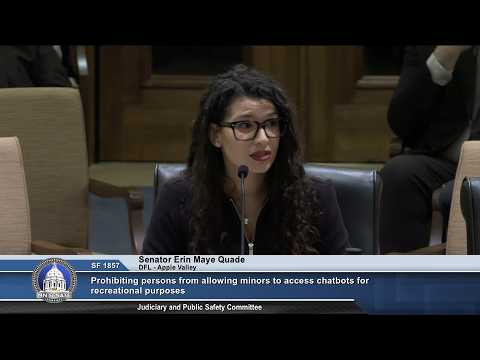
The Senate Judiciary and Public Safety Committee on March 9 took up Senate File 1857, a bill authored by Sen. Erin Maye Quade that would bar minors from accessing conversational AI "chatbots" and AI companions. The hearing featured testimony from suicide‑prevention advocates, industry representatives and technologists, and focused on definitions, age‑verification methods and civil remedies.
Sen. Maye Quade described multiple anecdotal cases of adults and children who experienced severe harm after extended interactions with conversational AI and argued the bill seeks to prevent similar harms to minors. "AI companions pose an unacceptable amount of risk to teens and children," she said, citing reports of self‑harm and other dangerous outcomes.
Erich Mische, CEO of Save Suicide Awareness Voices of Education, supported the bill as a public‑health measure and urged strong guardrails. A Transparency Coalition cofounder who testified online also urged Minnesota to act, pointing to other states' efforts.
Jarrett Catlin of TechNet and other industry witnesses opposed the authors' broad approach. Catlin said the bill's definitions could sweep in general‑purpose AI tools and make Minnesota an outlier; he suggested targeted safety protocols (for example, suicide‑prevention protocols and clearer companion‑tool definitions) rather than a categorical ban.
Committee members focused on three drafting challenges: how to define "chatbot" versus "AI companion," what prescriptive (if any) age‑verification techniques should be required, and whether civil‑liability provisions in the draft would create unintended strict‑liability exposure for companies that adopt reasonable safeguards. The author said she wanted strong deterrent remedies but also agreed to work with counsel and stakeholders to clarify standards and liability thresholds.
Procedurally the committee adopted an A2 delete‑everything amendment earlier in the hearing as the working text for SF1857 and ultimately laid the bill over so the authors and stakeholders could refine age‑verification, enforcement and remedy provisions before further committee action.