Get Full Government Meeting Transcripts, Videos, & Alerts Forever!
Get email alerts on the Ai Policy topic
No spam. Unsubscribe anytime.
Experts tell Senate committee Minnesota needs AI labeling, human review and privacy safeguards
Summary
Two expert witnesses told the Senate Judiciary and Public Safety Committee that government use of AI and generative models requires broad study, mandatory human review of high‑stakes outputs and clearer rules to prevent data leakage and misleading AI‑generated content.
Matt Ehling, a volunteer board member of Minnesotans for Open Government, told the Senate Judiciary and Public Safety Committee on March 9 that state oversight of government AI use should be broad and include labeling and human review.
"Government oversight flows from understanding when and how decisions are made," Ehling said, arguing that labeling of AI outputs and requirements for human review are necessary where automated systems affect constitutional or statutory rights. He warned generative models can fabricate legal citations and can leak private data entered into commercial systems.
Jarrett Catlin, policy adviser with TechNet, said states are moving rapidly on AI and cautioned against a patchwork of inconsistent rules. "One of our main concerns is the risk of patchwork without coordination across states," Catlin said, urging lawmakers to distinguish high‑risk AI uses from routine automation and to adopt consistent definitions and targeted safeguards.
Both witnesses highlighted data‑privacy risk and the need to protect nonpublic government information from being entered into commercial generative services. Ehling pointed to Minnesota Information Technology guidelines (MNIT) and called for evaluating whether advisory guidance should be codified.
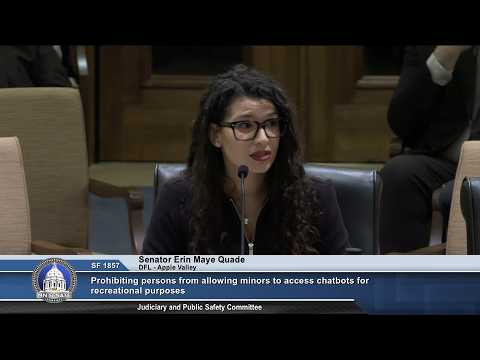
The committee heard the presentations before taking up several AI bills so members could better understand the policy tradeoffs. The testimony framed later debate over bills that would restrict certain law‑enforcement uses of geo‑data and restrict minors' access to conversational AI.