Get Full Government Meeting Transcripts, Videos, & Alerts Forever!
Get email alerts on the School Funding topic
No spam. Unsubscribe anytime.
Public hearing on LD 2226 spotlights large shifts to Maine school funding formula and sharp questions on special-education changes
Summary
The Joint Standing Committee on Education and Cultural Affairs heard hours of testimony on LD 2226, a proposal to overhaul Maine’s EPS school funding formula; the Department of Education and many superintendents supported updates to regional cost adjustments and poverty weighting, while school officials and municipalities urged caution over proposed special-education caps and potential local funding losses.
The Joint Standing Committee on Education and Cultural Affairs on March 3, 2026 held a lengthy public hearing on LD 2226, a committee bill to amend Maine’s Essential Programs and Services (EPS) school funding formula. The Department of Education signaled support for the bill’s framework and MEPRI modeling, while school leaders and municipal officials gave a mix of strong endorsements and warnings about localized fiscal impacts.
Representative Kelly Nunan Murphy introduced LD 2226, saying the committee referred the bill to update EPS after MEPRI’s review and simulation work. “This bill represents months of dedicated work,” the Department’s Paula Grall told the committee in technical testimony, outlining proposed updates to the regional (labor-market) adjustment, a variable weight for students identified as economically disadvantaged, transportation formulas and statutory references that align staffing and instructional costs. Grall said the department recommends implementing any changes for the 2028 school year and will provide more simulation results at work sessions.
Why it matters: supporters argue the formula currently ties state aid too tightly to property valuation and leaves high-poverty, land-rich communities with inadequate state support. Several superintendents and legislators said the proposed changes would shift tens of millions in state aid toward high-poverty districts and help districts cover transportation, special-education and staffing costs. Superintendent Jeremy Ray said the data and simulations showed a clear direction for reform and warned, “Waiting is not a decision.”
Supporters and their cases: lawmakers and superintendents from rural and coastal districts described concrete hardships. Representative Mark Malin said his district’s students are concentrated in poverty and cited a simulation in which his community would gain funding; Matt Nelson, Sanford superintendent, said children in high-poverty districts “cannot wait any longer” for funding that reflects their needs. Dozens of superintendents and local leaders urged the committee to advance the formula changes while continuing technical work on special education.
Areas of agreement: many witnesses—including municipal associations, the Maine School Superintendents Association, MSBA and the Maine Education Policy Research Institute (MEPRI)—endorsed modernizing the regional cost index, updating transportation cost calculations, and replacing a flat additional weight for economically disadvantaged students with a variable weight tied to concentration of need. MEPRI staff said those changes are supported by empirical analysis and would more accurately reflect current labor and living-cost patterns.
Points of contention: proposed special-education adjustments drew the most pushback. Several witnesses warned that the bill’s language would remove or narrow existing safety valves at the same time it modifies other parts of EPS. Concerns included replacing the high-cost out-of-district tuition adjustment with a different hardship mechanism, an 80% maintenance-of-effort cap that the Department supported in principle, elimination of midyear relief for some placements, and a higher threshold for hardship petitions. School leaders and analysts cautioned the committee not to eliminate multiple special-education protections at once without modeling the combined fiscal impact.
Local impact and equity trade-offs: municipal and school officials from communities projected to lose aid—including Scarboro—asked the committee to broaden the income proxy for ability to pay (for example, median household income or total taxable income) because using only the share of economically disadvantaged students can undercount year-round household capacity in towns with many seniors or seasonal properties. Scarboro witnesses said the district faced the largest projected loss (about $1 million) and urged a hold-harmless or phased approach to prevent sudden cliffs in aid.
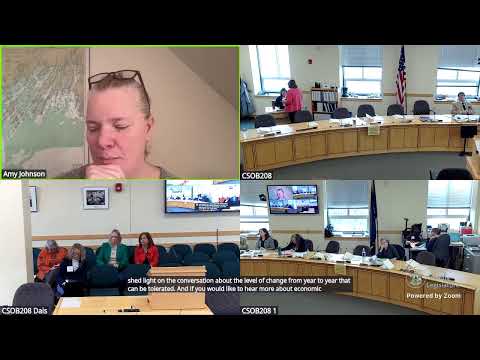
Modeling and next steps: witnesses repeatedly urged the committee to review additional MEPRI and DOE simulations. Paula Grall said DOE would aim to have more detailed special-education and transportation simulations ready for work sessions within about one to two weeks. MEPRI co-director Amy Johnson told the committee MEPRI could provide alternative metric scenarios and help clarify language to avoid unintended statutory vagueness.
What the committee must decide: members now must balance the bill’s redistributive equity goals with requests for guardrails—hold-harmless provisions, phased implementation or transition funding and more complete modeling of combined special-education changes—before reporting a final bill to the Legislature.
The committee closed the hearing and signaled that staff will schedule work sessions in which DOE and MEPRI will present additional modeling and revised bill language for committee consideration.