Get Full Government Meeting Transcripts, Videos, & Alerts Forever!
Get email alerts on the Land Use Zoning topic
No spam. Unsubscribe anytime.
San Marcos Council holds contentious hearing on proposed Francis Harris Lane data center
Summary
After hours of public comment, the San Marcos City Council held a public hearing on a developer'led proposal to change the preferred scenario and zoning to allow a large data center at Francis Harris Lane; council did not vote but heard competing claims about water use, enforceable restrictive covenants, noise and local control versus ETJ development.
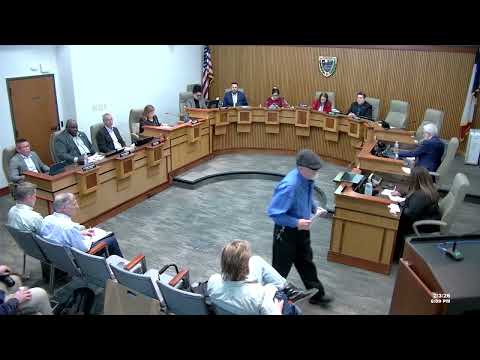
The San Marcos City Council held a lengthy public hearing on Feb. 3, 2026 about a resubmitted preferred-scenario amendment and zoning package to enable a roughly 200-acre data center project on Francis Harris Lane, across from the Hayes Energy power plant. The council did not take a final vote on the project at the meeting; staff and the applicant outlined proposed mitigation and neighbors and community groups urged more study and delay.
The project applicant, represented at the meeting by John Mayberry and civil and planning consultants, said the proposal includes a legally binding restrictive covenant that would cap on-site water at 75,000 gallons per day, restrict impervious cover, set site noise measuring rules with a 75 dB limit, commit the project to pursuing a LEED-equivalent certification and provide injunctive remedies for covenant violations. "We registered these commitments because we want the project under city control — not in the ETJ where the city could not enforce them," the applicant said during his remarks.
Neighbors and dozens of public commenters urged council to deny the preferred-scenario amendment (PSA 25-01) and the related rezoning. Speakers cited long-term regional drought, groundwater and surface-water constraints tied to Crystal Clear Special Utility District supplies, potential air-quality impacts, a historic cemetery located on the site perimeter, and what they described as inconsistency with the city's comprehensive plan. "This would use precious water and lock in industrial use next to families," several residents said, asking the council to preserve the conservation/cluster land-use designation.
Union representatives, tradespeople and others testified in favor of the project, saying construction-phase jobs and local wage and apprenticeship commitments could benefit the community. Labor leaders said they had negotiated project commitments for registered-apprenticeship work and family-sustaining wages on construction contracts.
Staff presentations addressed four recurring technical concerns raised by residents: water, noise, power-grid dependency, and fiscal implications. Planning and development staff explained that the site sits primarily within the city limits but includes roughly 60 acres in the extraterritorial jurisdiction (ETJ), and that the city's ability to require covenants and standards on city land is the primary policy tradeoff council must weigh. Engineering staff described proposed drainage improvements that would reduce post-construction runoff by roughly 10% compared with the existing condition. City staff also shared a draft restrictive covenant prepared by the applicant as a exhibit to the hearing packet.
On water, staff noted Crystal Clear SUD has a Certificate of Convenience and Necessity for the site and that the applicant has a water contract historically sized for residential uses; staff said the applicant proposes to reduce contracted allocation via covenant and use a closed-loop, non-evaporative cooling system on-site. Residents and a Crystal Clear board member countered that the existing contract is restricted to residential uses and cannot automatically be reassigned to industrial/commercial uses, and asked council to obtain a written statement from Crystal Clear before any vote.
On noise, staff said the proposed 75 dB standard would be stricter than some code thresholds and that cities can require mitigation measures such as berming, sound barriers and equipment enclosures. But multiple speakers highlighted the experience of other communities where data-center noise complaints required expensive retrofits.
Staff and the applicant noted the project could generate substantial taxable investment (applicant-provided scenarios ranged into hundreds of millions) and argued that an in-city development gives the city regulatory leverage and local tax revenue that would be absent if the same use were built in the county or ETJ. Opponents said those financial projections assume no abatements and warned that state incentive programs and future grid additions could change counting and water impacts.
What happens next: Staff and applicants said the formal votes on the preferred-scenario amendment and related zoning are scheduled for Feb. 17 (first reading/public hearing) and March 3 (second reading) under the city's calendar. Council members repeatedly asked for clear written clarifications on Crystal Clear's contract limits, the precise covenant language and enforceability, and the water accounting tied to power-generation sources used by the regional grid.
Why it matters: The decision frames a larger regional debate: whether fast-moving data-center proposals should be put under a municipality's direct authority (and therefore subject to local covenants and enforcement) or whether they will be built in ETJs and counties where the city has less jurisdiction. Council members and staff repeatedly emphasized that the choice is not only technical but a local policy question about where local oversight yields stronger protections for water, noise and public health.
Council did not vote on the PSA on Feb. 3; the applicant and opponents must return for the February public hearing and subsequent readings. The hearing packet included the draft restrictive covenant, water supply maps and staff analyses.