Get Full Government Meeting Transcripts, Videos, & Alerts Forever!
Get email alerts on the Elderly Tax Relief topic
No spam. Unsubscribe anytime.
Committee sends elderly tax relief extension to Hartford City Council with favorable recommendation
Summary
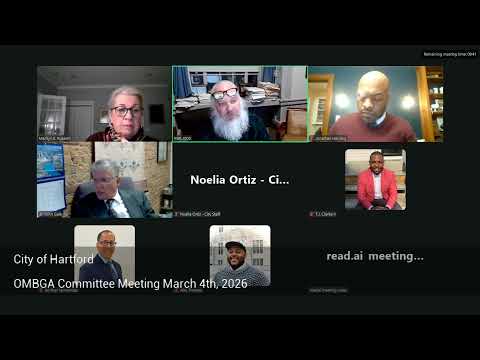
On March 4, 2026, Hartford City's Operations, Management, Budget, and Government Accountability Committee voted to send a mayoral amendment to Section 32-18 extending the city's elderly tax relief program to the full City Council after an annual presentation by Tax Assessor John Phillip on program history, costs and outreach.
HARTFORD CITY — The Operations, Management, Budget, and Government Accountability Committee voted March 4 to send a mayoral amendment to Section 32-18 of the municipal code to the full City Council with a favorable recommendation, after a briefing from Tax Assessor John Phillip.
Phillip said the amendment is an annual, technical update to keep eligibility thresholds tied to current values and income limits so residents do not lose benefits when HUD and other indexes change. "If we were not to do this, you know, about 700 elderly taxpayers would lose a benefit that for most is about $1,000 in taxes," he said.
The program has existed in one form or another since 1982, Phillip told the committee. He said the benefit amount has increased over time — historically a $500 flat grant for qualified residents and more recently raised toward $1,000 — and a $1,500 provision that once applied to owner-occupied four-family homes no longer affects any current recipients because the city has no such qualifying properties now. Phillip said last year the program cost about $680,000 and benefited roughly 725 taxpayers.
A committee member asked whether raising the income limits to mirror the U.S. Department of Housing and Urban Development(HUD) low-income thresholds would allow the assessors office to estimate how many additional elders might qualify. Phillip said the office does not keep formal records of applicants who are turned away and therefore could not provide a precise count, though he said annual participation has typically ranged between about 650 and 750 people.
On outreach and timing, Phillip said the application window is generally Feb. 15 through May 15, with May 15 a statutory deadline; applications cover a two-year eligibility period. The assessors office conducts mailings to prior participants and to people who have expressed interest, and staff will make accommodations such as house calls for applicants who cannot come to city offices.
Councilman John Gale moved to send the amendment to full council with a favorable recommendation; a second was made but not named in the meeting record. The committee approved the motion by voice vote; the meeting record did not include a roll-call tally. Chair Councilwoman Rosetti then adjourned the meeting.
The amendment now advances to the full Hartford City Council for consideration; the committee did not take a final vote to enact the change.