Get Full Government Meeting Transcripts, Videos, & Alerts Forever!
Get email alerts on the Lead Service Line Finance topic
No spam. Unsubscribe anytime.
Massachusetts offers 0% SRF loans and roughly 40% loan forgiveness for lead service line replacements
Summary
The Clean Water Trust and Massachusetts Department of Environmental Protection outlined 0% interest planning and construction loans for lead service line replacement, with roughly 40% loan forgiveness, funded via SRF grants tied to federal infrastructure dollars; applications are rolling and project readiness is prioritized.
The Clean Water Trust and the Massachusetts Department of Environmental Protection on the webinar described 0% interest State Revolving Fund loans to help public water systems identify and remove lead service lines, and said roughly 40% of such loans will be forgiven while funding lasts.
Jonathan Maple, senior policy analyst at the Clean Water Trust, said the trust and MassDEP jointly administer the Clean Water and Drinking Water SRFs and that ‘‘there’s two different programs here: 0% interest lead service line planning loans and 0% interest lead service line construction loans.’’ He said SRF grants from the U.S. Environmental Protection Agency, supplemented by state match, fund the 0% loans and the loan-forgiveness component.
Why it matters: the presenters said the federal Infrastructure Investment and Jobs Act significantly increased SRF funding; Massachusetts expects about $240 million in lead service line grant funds to support inventories and replacements. That funding is time-limited and distributed based on project readiness, the presenters said.
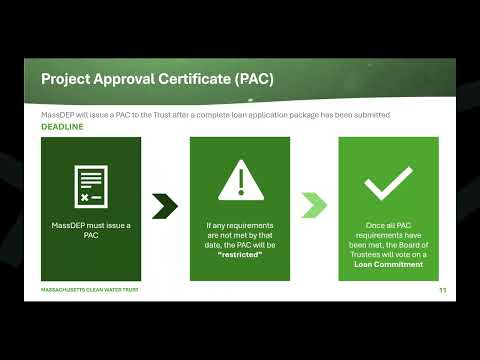
How the programs work: planning loans support service-line inventory refinement, records review, GIS mapping, outreach, and replacement-plan development. Construction loans cover public- and private-side full replacements and associated investigations (for example, test pits and other invasive investigations). MassDEP issues project-approval packages; restricted packs can be issued if requirements are unmet. After MassDEP approves a project, the Trust’s board typically votes monthly on loan commitments and issues financing packages and closing instructions.
Loan terms and repayment: the Trust said interim construction financing is offered at 0% interest with no fees; projects commonly remain in interim financing one to two years before moving to permanent repayment. The Trust requires a green-light letter from local bond counsel and a loan questionnaire to confirm tax-exempt bond compliance and sources of repayment. Final repayment schedules list payments due Jan. 15 and July 15 each year.
Loan forgiveness and limits: presenters said roughly 40% loan forgiveness has applied to lead service line projects to date; they cautioned availability is limited and can change as funds are committed. Jonathan said the SRF lead grant program requires a sizable portion of funds be provided as loan forgiveness and urged communities to apply while funds remain available.
What’s next: communities interested in SRF lead service line financing must prepare application packages for MassDEP—plans, specifications, local debt authorizations and required SRF documentation—to receive a project-approval package. The presenters emphasized that readiness (complete plans, procurement readiness, and required local votes) speeds commitments.