Get Full Government Meeting Transcripts, Videos, & Alerts Forever!
Get email alerts on the State Legislation topic
No spam. Unsubscribe anytime.
Northwest Allen County Schools officials outline legislative changes affecting phones, funding and teacher contracts
Summary
District leaders briefed the board on several recently enacted Indiana bills: SB 78 will ban student phone use during the school day with secured-storage requirements; HB 104 removes a teacher-contract hour requirement and adds parent internet-filter options; HB 1210 and HB 1242 change local fund transparency and require statewide reporting that could affect district funding and reporting.
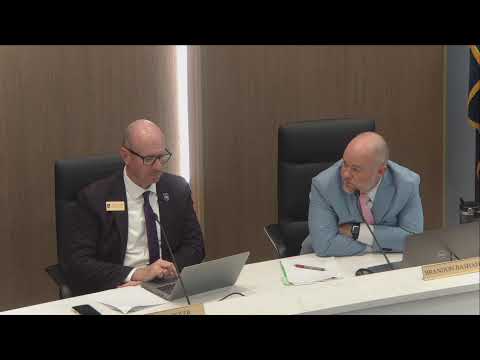
The Northwest Allen County Schools board heard a legislative briefing on March 9 that laid out a series of state law changes district staff said will affect policy, day-to-day operations and revenue timing.
Recorder (the districts legislative presenter) summarized major measures passed when the General Assembly adjourned. He said House Bill 104 removed the statutory requirement to include daily teacher work-hour counts in employment contracts and requires school corporations to adopt a policy enabling parents to strengthen their childs internet filter and block access to specified websites and device functions. "We have to learn a little bit more about that to get an understanding of what those technology requirements are," the recorder said, adding the district will monitor forthcoming guidance.
On student devices, the presenter described Senate Bill 78 as a ban on student cell-phone use during the school day unless the devices are stored in secured locations and turned off. "A locker is considered secured storage," the recorder said, and the state Department of Education is expected to issue implementation guidance. Board members questioned how schools will enforce the rule and whether the law implies each student must have a locker; the recorder said guidance from the DOE is expected in the coming month and acknowledged enforcement will be an administrative burden.
On finance and reporting, the recorder described House Bill 1210s changes to local government finance: among other items it permits certain homestead-credit allocations across funds, allows excise-tax distributions to be deposited into any school-maintained fund, and requires municipal-adviser contracts to be posted publicly (district website and the DLGF gateway). He also summarized House Bill 1242, which directs the Department of Education and the DLGF to compile statewide school data and study disparities in per-student operational funding.
District staff warned about timing and near-term cash impacts. Mr. Basham, the business director, said the district will receive about $1.2 million in curricular-material reimbursement this year but that a large English textbook adoption can cost $1.5—.8 million in a single year; moving those reimbursements across funds, he said, changes cash-flow dynamics and can make the education funds cash balance appear more volatile. He also flagged a roughly $1.2 million impact from changes associated with HB 1210 that the district expects to split across debt-service and operations funds (approximately $600,000 this year), and said staff are preparing scenarios to smooth the effect.
Board members asked for follow-up detail on projected dollar impacts and timing. The district committed to returning with clearer financial estimates when personal-property valuation updates and DOE guidance are available, and to present policy revisions (including any locker/phone policy) for board consideration after legal counsel and DOE guidance are published.
The briefing closed with the district noting next procedural steps: legal review and policy updates (expected April/May), fiscal scenario modeling over the coming months, and potential board discussions of fee or consumables policy changes for the next school year.