Get Full Government Meeting Transcripts, Videos, & Alerts Forever!
Get email alerts on the Public Works topic
No spam. Unsubscribe anytime.
Gautier City outlines street shortfall, flags $16–$18 million High Street Viaduct as sales-tax vote nears
Summary
City officials at a city-coffee briefing explained how a proposed half-cent capital-improvement sales tax (on the August ballot) would fund streets, stormwater, transit and airport match funds, but said the city still faces a roughly 54% shortfall on immediate street needs and a $16–$18 million funding gap for the High Street Viaduct.
Gautier City administrators and public-works staff used a public "city coffee" meeting to sketch how a proposed half-cent capital-improvement sales tax on the August ballot would be divided and to lay out the department's most urgent priorities.
City Administrator Brian Crane told attendees that the city's overall local sales-tax rate is roughly 2.25 percent and that the half-cent measure would be used for capital projects across departments. He said the proposed split would allocate 59 percent of the CIP funds to public works, about 20 percent to public safety, 10 percent to parks, and the remaining 10 percent as a flexible pool for IT, GIS and contingencies. "It funds a majority of our capital improvements, especially for public works," Crane said.
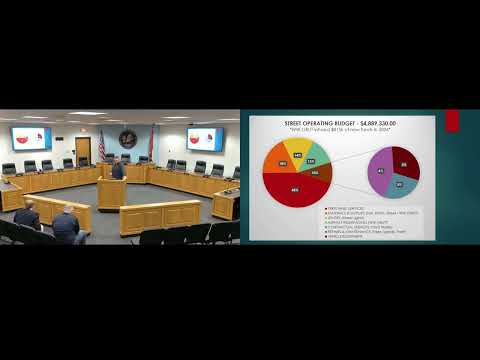
Why it matters: staff said the city needs a little over $5 million for street repairs. Crane and public-works presenters explained the CIP currently covers roughly 34 percent of that need; a recent wastewater user-fee transfer added about 12 percent (roughly $800,000), leaving the city approximately 54 percent short of the identified funding requirement. Without the CIP, staff said, the city would be significantly worse off.
Staff highlighted how the sales tax has previously underwritten major projects — including the Wildwood extension — and emphasized that the council voted this year to place a 10-year (rather than five-year) renewal on the ballot to enable longer-range planning and better grant leverage.
Key projects and gaps: the presentation identified a menu of priority initiatives that the CIP would support, including overlays/surface maintenance, stormwater work, sidewalk and grant-matching for enterprise accounts (airport and transit). Of particular concern is the High Street Viaduct, which staff estimated would require between $16 million and $18 million to repair or replace. "That's going to be a tough one to bite off if it's just city and county throwing money into it," Crane said, noting staff are pursuing state and federal grants and preparing shovel‑ready plans.
Facilities and fleet needs: staff said the Easton maintenance facility was demolished and that a replacement on the city's east side is a capital priority to support winter operations and material storage. The central maintenance shop also was described as overcrowded (serving roughly 500 vehicles and equipment) with limited amenities; staff said improving the shop would aid recruitment and operations. Transit staff noted that the CIP is used to match federal bus grants and to fund scheduling and dispatch software.
Funding mechanics and recent changes: presenters described a recent change in how contingency dollars are released to splits, which temporarily increased overlay funding in a previous year, and noted that a transfer from wastewater operations (a payment-in-lieu-of-tax style transfer) contributed the roughly $800,000 now available for road work. Staff said overlay spending is currently around $2.4–$2.5 million, up from about $1.3 million three years earlier.
County perspective and materials costs: a county official at the meeting urged consideration of bonding or low‑cost loans for large projects, saying that post‑COVID construction cost escalations make pay‑as‑you‑go approaches less effective. Participants also discussed the rising price of asphalt (cited as roughly $20/ton historically versus about $105/ton today) and a local dispute in which some residents objected to a chip-seal preservation treatment instead of a full asphalt overlay; staff defended chip seal as a cost-effective preservation method in appropriate contexts and explained limitations in the city (curb and gutter make chip seal less suitable than in some county roads).
Concrete and stormwater work: staff acknowledged concrete streets have received less attention historically and said the wastewater transfer allowed contracting of about $400,000 for concrete repairs and another $400,000 for stormwater patching. They described the overlay process in detail — inspecting bases and storm systems, performing patching and inlet work before a mill-and-fill overlay — and warned that poor subbase conditions shorten overlay life.
Next steps: staff urged voters to consider the August ballot measure to secure a 10‑year CIP horizon and said they will continue preparing grant applications and shovel‑ready plans for large projects. The meeting closed with an invitation to the next city coffee (parks) and time for follow-up questions from residents and staff.