Get Full Government Meeting Transcripts, Videos, & Alerts Forever!
Get email alerts on the Waste Characterization topic
No spam. Unsubscribe anytime.
Clark County study finds large share of landfill-bound garbage is recoverable; edible food waste tops list
Summary
A Clark County waste-characterization study found about 45% of material entering the countygarbage stream could be recovered via recycling, composting or specialty programs, with edible food/vegetative waste the single largest recoverable category, presenters said.
Sarah Schrader, an environmental operations specialist who managed Clark County—s recent waste-characterization study, told the Solid Waste Advisory Committee the county sampled 244 loads across all four seasons in 2025 to measure what residents and businesses are sending to the landfill.
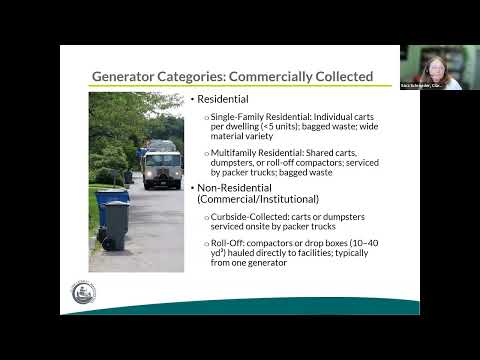
The study categorizes waste by generator type (single family, multifamily, commercial and self-haul) and material groups. Schrader said the countywide breakdown by tonnage was roughly 10% commonly recyclable, 8% less recyclable, 15% commonly compostable, 2% less compostable, 10% potentially recoverable and 54% non-recoverable. She summarized the finding: "54% of the waste that came in as garbage was actually garbage and inappropriately landfill bound." The study also reported an overall recoverable fraction of about 45 percent, equivalent to roughly 190,000 tons in the county—s estimate (report tables include rounding explained by the presenter).
The three largest recoverable material groups across the county were edible food/vegetative waste, furniture and cardboard/craft packaging. Schrader said edible food waste included wet items with higher moisture content and that the study separates edible from inedible vegetative material (for example, an intact apple vs. an apple pit).
Substream results pointed to specific intervention opportunities. Single-family households showed a large share of commonly compostable material (about 12% edible food waste); multifamily properties had higher rates of commonly recyclable material in the trash than single-family homes, a disparity the presenter flagged as an access and contamination issue that could be improved through targeted collection options and education.
The presentation included a 5,100-respondent self-haul survey: 75% of respondents were residential self-haulers, 25% non-residential, and roughly 70% of self-haul customers were city residents. Schrader said residential self-haul was dominated by bulky items and one-time cleanouts, while non-residential self-haul tended to include construction material and dimensional lumber.
Committee members and contractors pressed presenters on study limits. One participant asked whether measuring by tonnage (the study—s reported metric) understates materials that take more volume when compacted in the landfill. Schrader responded that the study is tonnage-based and does not include per-item counts, and that counting items would have significantly increased the study cost.
Questions about multifamily recycling focused on contamination and service models. Waste Connections staff described a dedicated multifamily recycling educator who visits sites and works with property managers; participants noted challenges when third-party services (for example, valet collection providers) deposit recyclables in inappropriate enclosures and called for site-specific signage, education and, in some cases, property-level interventions.
Schrader said the county will incorporate the study into the solid-waste management plan, use the data to compare local performance to state benchmarks, and target outreach and infrastructure investments (transfer-station planning, collection-contract revisions and organics hubs). She highlighted current efforts to expand community drop-off compost hubs and noted that only a limited set of cities currently offer curbside food-waste collection, citing capacity constraints.
The presentation concluded with staff recommendations to use the data for targeted diversion campaigns, to inform contract and transfer-station decisions, and to support grant or budget requests for scaling organics programs. No formal policy changes or votes were taken at the meeting; staff said findings will inform future budget and program proposals and outreach activities.
The SWAC will revisit program and outreach updates at subsequent meetings; the committee—s next scheduled meeting is August 6.