Get Full Government Meeting Transcripts, Videos, & Alerts Forever!
Get email alerts on the Strathormuz Resolution topic
No spam. Unsubscribe anytime.
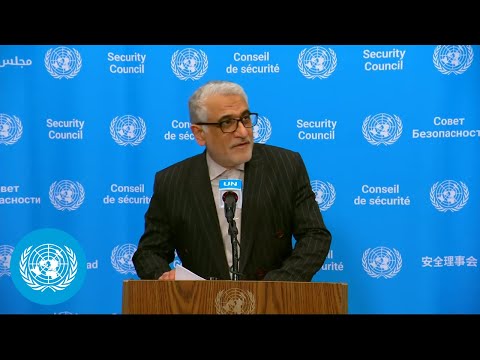
Iran representative urges U.N. members to reject U.S.-backed draft resolution on Strait of Hormuz
Summary
An Iranian presenter told the U.N. Security Council the U.S.‑ and Bahrain‑backed draft resolution on the Strait of Hormuz is 'deeply flawed' and urged member states to reject it, accusing the United States of a maritime blockade and of escalating regional tensions.
The Iran representative, speaking as a presenter to the meeting, urged U.N. member states to reject a U.S.- and Bahrain-backed draft resolution on the situation in and around the Strait of Hormuz, calling the text "deeply flawed, one-sided, and politically motivated."
He said the sponsors "claim that their actions are intended to protect freedom of navigation in the Strait of Hormuz" but argued those actions "stand in the stark contradiction to [their] stated objectives and have served only to escalate tensions and deepen instability in the region."
The presenter framed Iran's position as a call for an end to hostilities and restoration of maritime access: "The only viable solution in the Strait of Hormuz is a permanent end to the war, the lifting of maritime blockade, and the restoration of normal passage." He said Iran's actions in the Strait are "consistent with international law" when taken in defense of a coastal state subject to aggression.
On specific allegations in the draft, he rejected claims that Iran had violated the 8 April ceasefire and said sponsors had not presented "credible and verified evidence" of attacks on vessels or placement of sea mines. He described the allegation that Iran placed sea mines as "entirely misleading" and said it served political objectives while ignoring, in his view, a U.S. maritime blockade and seizures of Iranian vessels.
The presenter also criticized what he described as a selective invocation of international law, saying sponsors invoke the United Nations Convention on the Law of the Sea while disregarding what he called "egregious violations" by the United States. He objected to invoking Chapter VII of the U.N. Charter, calling it "wholly unjustified, disproportionate and based on politically motivated allegation" and warned that adoption "would seriously damage the credibility and impartiality of the Security Council."
The speech included broader accusations that the United States "initiated two wars of aggression against Iran," violated the U.N. Charter and international humanitarian law, and had a record of noncompliance with International Court of Justice judgments. He cited past ICJ cases including Nicaragua and the Corfu Channel judgment to argue the United States lacks standing to assert international-law credentials.
The presenter closed by urging member states to "take a principled and responsible position by rejecting this draft resolution and refraining from supporting or co-sponsoring it," and asked rhetorically how U.S. actions — described as demanding fees on passing vessels and seizing ships — could be reconciled with international law.
The remarks were a formal intervention to the Council; the transcript records no immediate response or vote within these segments.