Get Full Government Meeting Transcripts, Videos, & Alerts Forever!
Get email alerts on the Infrastructure topic
No spam. Unsubscribe anytime.
Council holds hearing on north‑side reconstruction project and approves facility plan
Summary
City engineer presented a public hearing on a proposed multi‑block north‑side streets and utilities reconstruction covering roughly 38 blocks; council approved the facility plan and will pursue funding including grants, utility funds, and special assessments.
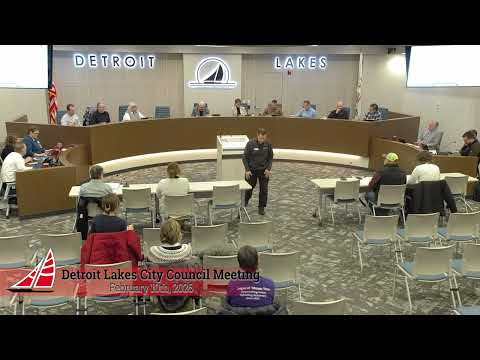
City engineer John Pratt told the Detroit Lakes City Council on Feb. 18 that the proposed north‑side street and utility reconstruction would consolidate work across about 38 blocks between Highways 10 and 34 and from Washington to Roosevelt. Pratt said much of the sewer and water collection infrastructure in that area dates to the 1920s–1930s and is approaching the end of its useful life, with failing brick manholes and cast‑iron water mains that are prone to breaks.
Pratt reviewed alternatives and said trenchless methods were not practical for the scope and condition of the existing utilities; the project team is planning traditional open‑cut replacement of sewer mains (with PVC) and precast manholes, replacement of service laterals to the right‑of‑way (with property owners responsible for laterals beyond the right‑of‑way), and generally 36‑foot street widths with strategic widenings where higher traffic requires it. He described potential sidewalk standards (one side of the street with a turf boulevard) and said the report assumes one sidewalk per street for cost estimating.
The preliminary engineering report estimates total project costs in excess of $15 million and projects that roughly three‑quarters of that cost would be borne by the city (utility funds, levy) while about one quarter would be assessed to benefiting properties. Pratt presented example assessments: street and sidewalk assessments of roughly $115 per front foot (residential), sewer service laterals just over $4,000 each, and water service laterals about $5,500 each. Under the staff estimate, a typical 50‑foot residential lot could face assessments in the ballpark of $15,000–$18,000 depending on services and lot width. Pratt said staff will pursue funding from the Minnesota Public Facilities Authority and other sources but stressed there is no guarantee of grant awards.
Following the public hearing and staff presentation, council considered a resolution to approve the facility plan required for future grant applications and assessment hearings. A motion to approve the facility plan passed. Pratt and staff said the earliest aggressive schedule would put construction bids and an assessment hearing in 2027 with construction possibly staged over two years; the schedule depends on funding and permitting.
Next steps noted by staff include final design through 2026, televising of mains where needed to refine scope, property‑level assessment calculations and a formal assessment hearing when bids are available.