Get Full Government Meeting Transcripts, Videos, & Alerts Forever!
Get email alerts on the Energy topic
No spam. Unsubscribe anytime.
MCE tells Lafayette council community choice brings local control, new rebates and a virtual power plant pilot
Summary
MCE representative Sebastian Khan told the Lafayette City Council that community choice aggregation gives local control over generation, highlighted local rebates and greenhouse-gas reductions, and described a virtual power plant pilot and a $10 million "MCE Cares" fund for low-income customers.
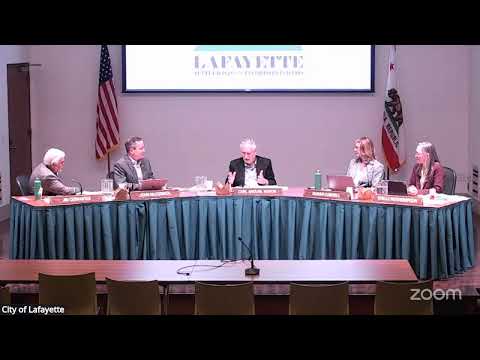
Sebastian Khan, a representative of the community choice energy provider MCE, told the Lafayette City Council that community choice aggregation provides local control over electricity generation and the ability to prioritize renewable resources. "Community choice energy is one of the most effective tools that local governments have in addressing climate change," Khan said at the council meeting.
Khan described MCE's standard product, the Light Green service (60% renewable), and the opt-up Deep Green product (100% renewable). He said about 90% of Lafayette customers participate in MCE and roughly 8% have opted up to Deep Green. Khan noted that MCE reduced its generation portion of rates by about 14% this year and applied an additional bill credit to help offset recent PG&E exit-fee increases.
Khan detailed customer-facing programs for Lafayette: EV rebates (up to $4,000 for a new vehicle, $2,000 for used) totaling about $119,000, energy-efficiency rebates approaching $498,000, and an estimated 8,000 metric tons of CO2 avoided in Lafayette since the city joined MCE in 2016. He said MCE has set aside a $10 million "MCE Cares" fund that provides a $20 monthly bill credit for residents enrolled in state income-verified programs, and a $25 monthly credit for qualifying small businesses.
On future projects, Khan described a virtual power plant (VPP) pilot that aggregates distributed resources such as rooftop solar, batteries and smart devices to dispatch energy to the grid and improve reliability. He said the VPP is currently being rolled out in Richmond and deployed in partnership with nonprofits and using a social-impact bond to renovate housing and install participating technologies.
Council members pressed Khan for technical clarifications. One councilmember asked whether the Power Charge Indifference Adjustment (PCIA) surcharge covers PG&E'entered contracts; Khan said it generally reflects preexisting PG&E contracts that remain payable when load departs to a CCA. Another asked how MCE hedges against market volatility; Khan declined to delve into procurement specifics and offered to follow up with detailed procurement and finance information.
Public commenters raised questions about MCE'owned generation and how California accounts for large hydro and nuclear in utility mix calculations. Khan said renewable and greenhouse-gas accounting follow California Energy Commission rules: hydro is treated as greenhouse-gas free but not always counted the same as other renewables in certain regulatory tallies.
Khan closed by inviting the public to a May 26 power procurement workshop and urging residents to attend the June 5 workshop for more detail on procurement and contracts. "Programs like this give our residents a better understanding of not only what we do, but why we do it," he said.
Next step: the council's questions were addressed during the meeting and Khan offered to provide follow-up procurement and contract detail at a public workshop; no formal council action was required that night.