Get Full Government Meeting Transcripts, Videos, & Alerts Forever!
Get email alerts on the Labor Union Activity topic
No spam. Unsubscribe anytime.
Researchers tell Minnesota Senate panel that nursing homes use anti‑union tactics and spend hundreds of thousands to fight organizing
Summary
Two research teams told the Minnesota Senate Labor Committee that employer anti‑union tactics are widespread in state nursing homes and that some facilities spent hundreds of thousands of dollars on campaigns; a CNA and the Minnesota AFL‑CIO urged investigation and policy changes.
Researchers and workers told the Minnesota Senate Labor Committee that employer opposition to union organizing in Minnesota nursing homes is widespread and sometimes financed with large sums that, they said, could have gone to worker pay or staffing.
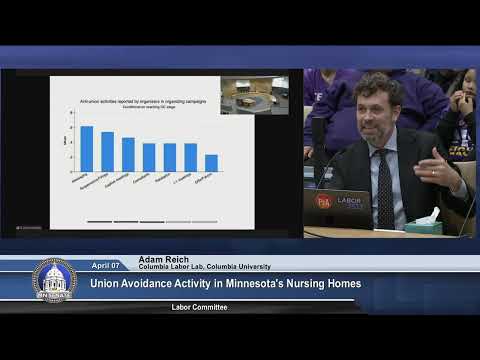
Adam Reiss, a professor of sociology at Columbia University and co‑director of the Columbia Labor Lab, presented a mixed‑methods study that combined interviews, union administrative records, employer materials and a July–August 2024 survey of the state’s certified nursing assistants. Reiss said the researchers sent the survey to 30,755 registered CNAs and received roughly 2,000 individual responses (about a 7% completion rate). "We find a consistent pattern of employer opposition to union organizing," Reiss said, and added that the behavior was most common in facilities that rely heavily on public funding and that also tended to have lower staffing levels and lower Centers for Medicare & Medicaid Services quality ratings.
A second presentation from Labor Lab (identified in the transcript as a Labor Lab researcher) estimated the full cost of anti‑union campaigns at five Minnesota nursing homes. The presenter described seven categories of cost — external spending on consultants, attorneys and materials plus internal costs such as paid managerial time and productivity losses — and gave case estimates. For example, the Chapel View Homes campaign was estimated to have cost between about $280,000 and $404,000; other campaigns presented ranged across tens to hundreds of thousands of dollars. The presenter said those sums were equivalent in some cases to multi‑percent wage increases for affected workers and argued the money could have been redirected to wages or voluntary recognition agreements.
Cassandra Thomas, a certified nursing assistant who said she works at Chapel View Homes, gave a first‑hand account of the workplace conditions Reiss and the Labor Lab described. Thomas said short staffing and low pay made daily care difficult and described employer efforts to persuade workers not to unionize — posters, one‑on‑one meetings, gift baskets and outside consultants visiting the floor. "We want the money going to the workers who make sure loved ones have dignity," Thomas told the committee.
Bernie Burnham, president of the Minnesota AFL‑CIO, testified that unions deliver higher pay and benefits and called the anti‑union activity documented in the reports "unacceptable" and "shameful," urging lawmakers to act to protect workers’ rights and residents’ care.
Committee members asked detailed questions about the research methods, disclosure rules for consultants and whether public subsidies could be indirectly supporting union‑avoidance spending. Senator Pappas said she was "pretty shocked at how much was spent on the anti‑union activities," and several members urged the committee or state agencies to examine whether taxpayer dollars were being used to fund such campaigns.
The presenters and testifiers urged further inquiry: Reiss recommended linking worker survey data to facility financial records to better identify causal relationships among anti‑union activity, staffing and quality of care; the Labor Lab presenter recommended legislative or oversight action to improve disclosure and consider neutrality or voluntary recognition approaches.
The committee made no formal vote or motion during the hearing. Chair McEwen thanked presenters and testifiers and said the committee would continue examining the issue.
Sources: testimony and presentations to the Minnesota Senate Labor Committee, including the Columbia Labor Lab report and a Labor Lab cost‑estimate report; testimony from Cassandra Thomas (CNA, Chapel View Homes) and Bernie Burnham (President, Minnesota AFL‑CIO).