Get Full Government Meeting Transcripts, Videos, & Alerts Forever!
Get email alerts on the Legislative Matrices topic
No spam. Unsubscribe anytime.
OHA trustees waive committee review and approve 2026 legislative matrices after public plea for fuller scrutiny
Summary
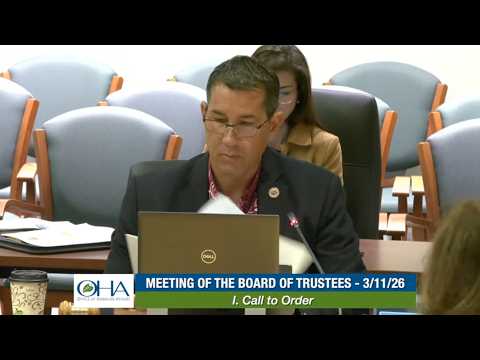
The Office of Hawaiian Affairs board voted to waive further committee review and approved staff-recommended positions across nine legislative matrices on March 11, 2026, after a community member urged more transparent committee deliberation.
The Office of Hawaiian Affairs board voted on March 11 to waive further Beneficiary Advocacy & Empowerment (BAE) committee review and approve staff recommendations on nine legislative matrices covering bills that affect Native Hawaiian communities.
A public commenter, Germaine Meyers, urged trustees not to waive committee review, saying the legislative matrices “represent the Office of Hawaiian Affairs formal policy positions on bills that affect Native Hawaiian and Hawaiian across the state” and that committee discussion provides “space for deeper questions, careful review, and beneficiary engagement.” The board proceeded with the waiver motion and the clerk announced the vote produced seven yes votes, carrying the motion.
Why it matters: OHA uses legislative matrices to set its formal testimony and positions. Committee review is a primary venue for in-depth questions and beneficiary participation; bypassing that step shortens the deliberative path staff positions typically follow before reaching the full board.
What the board approved: Over the course of the meeting trustees voted to adopt staff-recommended positions for matrices 1 through 9 (covering items such as commercial aquarium collection and land-use bills, public land trust measures, natural-resources bills, Native Hawaiian housing, health and education legislation, economic stability measures, and historic preservation bills). Most matrix votes were approved by roll call with seven yes votes; the final historic-preservation matrix recorded six yes votes and one abstention.
Notable staff updates included that three measures in matrix 1 (a commercial aquarium collection bill, a Land Use Commission bill and an island burial council bill) had been sent to the Senate but lacked committee referrals; matrix 2 contains two public land trust bills (HB2582 and HB2584) with referrals to Hawaiian Affairs and WHAM; and staff moved one item from “monitor” to “support” for a green-fee revenue bill.
Public input and next steps: Multiple public commenters from the Wai Coast and Nanakuli neighborhood boards urged trustees to consider localized infrastructure, cultural, and equity impacts when taking positions—asking specifically that certain measures (including SB2423/HB1734 on subdivision rules) be added to the appropriate matrices for fuller review. The board did not reopen committee review during the meeting; staff will proceed with the positions the trustees approved.
The board ended its BAE agenda items and moved to announcements and a scheduled executive-session item (the board later considered but did not enter executive session).