Get Full Government Meeting Transcripts, Videos, & Alerts Forever!
Get email alerts on the Homelessness topic
No spam. Unsubscribe anytime.
State law change reclassifies West Valley shelter, could save city $300K–$400K a year beginning 2027
Summary
A recent legislative package reclassifies West Valley City’s 24/7 shelter as a tier-one facility and removes its annual mitigation-fund payment; staff say the change will increase shelter funding and reduce a roughly $275,000 annual mitigation charge starting in 2027, but savings do not take effect until the next fiscal year.
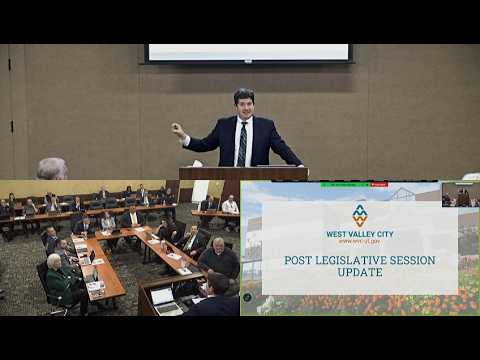
Sam Johnson, director of communications and government affairs, told the West Valley City Council on March 10 that recent state action will change how the city’s shelter is classified and funded.
Johnson said House Bill 596 was modified in the final days of the session and that language was later substituted into another bill that ultimately passed. Under the change, West Valley’s shelter will be treated as a tier-one shelter rather than a temporary winter shelter, which will end the city’s required mitigation‑fund contributions and increase state funding for tier‑one cities.
The staff estimate cited by Johnson places the annual savings at roughly $300,000 to $400,000. “This bill changes it and it does it in a significant way for all of us,” Johnson said, adding that the change “removes that $275,000 bill that we pay every year.” He emphasized, however, that the change goes into effect in 2027, so the city will continue its current mitigation payments through the remainder of the year.
Johnson said the change does not alter day‑to‑day operations: West Valley’s shelter has been operating 24 hours a day, year‑round for the past 2½ years, and that will continue under the new funding classification. He also explained that the bill includes a mitigation assessment that shifts costs among jurisdictions and allows certain cities to flex shelter capacity higher under specified fire-code limits.
The council asked several follow‑up questions about timing and long‑term shelter models. Johnson said a statewide review and potential campus‑shelter proposals are under way and that any changes would likely play out over multiple years. He warned that while the funding instrument improves the city’s fiscal position, it does not guarantee immediate operational relief because the exemption from mitigation payments begins in 2027.
The council took no formal action on the legislative outcome during the study meeting; the conversation was an informational update.