Get Full Government Meeting Transcripts, Videos, & Alerts Forever!
Get email alerts on the Shop topic
No spam. Unsubscribe anytime.
CTC adopts 2026 SHOP amid repeated public demands for stronger complete-streets compliance
Summary
The California Transportation Commission approved the final 2026 State Highway Operation and Protection Program (SHOP) after staff advised it is consistent with the asset management plan. Dozens of public commenters and advocates urged the commission to press Caltrans for earlier and clearer implementation of SB 960 'complete streets' requirements.
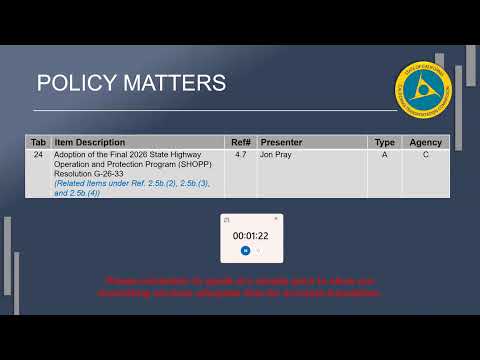
The California Transportation Commission on March 20 adopted the final 2026 State Highway Operation and Protection Program, a four-year, roughly $17.9 billion portfolio intended to preserve and protect the state highway system.
Commission staff told the panel the SHOP was prepared and submitted by Caltrans in accordance with Government Code section 14526.5 and that staff found the program ‘‘adequate and consistent’’ with the State’s transportation asset management plan after a review of nearly 600 projects and two public hearings. Staff noted funding decreases that required difficult trade-offs but said the final SHOP balances projects across primary asset classes.
Advocates and local officials used the commission’s public-comment period to press for more complete-streets investments and earlier transparency under SB 960. Sophia Rubicova of the Coalition for Clean Air told the commission the SHOP ‘‘proposes to add 200 miles of new bikeway facilities’’ but that the State Highway System Management Plan identified almost 2,000 miles needed to meet 10‑year goals. ‘‘This means that Caltrans is only proposing to build 11% of the infrastructure that the state truly needs,’’ she said.
Multiple commenters, including members of Climate Plan Network, CalBike and Streets for All, urged the CTC to require Caltrans to document and justify exemptions from SB 960 immediately rather than waiting until 2028, which Caltrans staff said is its planned reporting date. Commenters cited analyses showing a large share of SHOP projects lack ADA, bicycle, pedestrian or transit elements and asked the commission to press Caltrans for earlier baseline reporting and clearer rationale when complete-street features are omitted.
Caltrans acting statewide asset management engineer Diana Campbell described the program’s trade-offs and highlighted recent and planned lane‑mile additions for bike and pedestrian facilities. Campbell said the 2026 SHOP ‘‘does make bike and ped targets established in the 2025 SHSMP management plan per SB 960 requirements’’ and that the SHOP proposes more than 160 new lane miles of bikeways, an increase of more than 40% of the existing bikeway inventory. She acknowledged some projects were deferred to address critical statewide asset needs.
The commission moved to adopt the final 2026 SHOP as presented by staff. Commissioners noted the tension between asset preservation and emerging policy priorities—such as SB 960 and transit policy—and directed staff and Caltrans to continue engagement with local partners and advocates. The motion was seconded and carried.
What’s next: staff and Caltrans said the final SHOP will be submitted to the Legislature and Governor by April 1, and several commissioners requested follow-up briefings and more granular SB 960 implementation data to be supplied before the next major milestones.
Sources: CTC staff presentation and public comment at the March 20, 2026, CTC meeting; quotes from public commenters and Caltrans staff.