Get Full Government Meeting Transcripts, Videos, & Alerts Forever!
Get email alerts on the Road Maintenance topic
No spam. Unsubscribe anytime.
Cochise County supervisors weigh adding and dropping rural roads as budget pressures grow
Summary
County staff presented an updated road maintenance plan that would add about 3.44 miles and remove others to prioritize residents served; supervisors flagged several weather‑vulnerable roads and raised concerns that adding maintenance without new revenue could push highway funds into a shortfall.
County public‑works staff briefed the Cochise County Board of Supervisors on March 5 about an updated road maintenance plan that would reshuffle which rural roads the county maintains, including proposals to add roughly 3.443 miles of maintained roads drawn from a 4.51‑mile candidate list and to drop lower‑use stretches.
The presentation by county staffer Mr. Fosio laid out initial construction ('buildup') and recurring annual maintenance estimates for dozens of short segments across the county and explained the rationale—prioritizing roads that serve more residents or connect to existing maintained roads. "What we're here to talk about is the add/drop roads that we discussed at our last work session," Fosio told the board as he began the briefing.
Why it matters: supervisors and staff said several candidate roads are "weather‑event" roads—low‑lying or with constrained drainage—and would require repeated emergency repairs if the county assumes maintenance. Staff repeatedly warned that initial build costs can be high where there is no existing aggregate base or where extensive drainage work is required, while routine annual maintenance for some segments remains comparatively low.
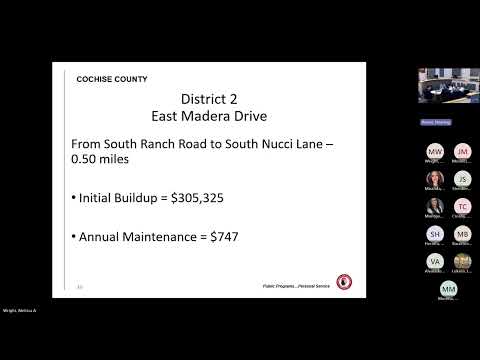
Key details and cost examples: staff narrowed the candidates by district and supplied specific build and annual maintenance estimates taken from project slides. Examples cited during the briefing included East Chipoa Street, a short connector with an initial buildup estimate of $101,330 and an annual maintenance estimate of $747; Kensington (0.25 mile) with an initial build estimate of $101,430; and Kevin Street with a $51,750 initial estimate. South Nucci Drive was cited as a half‑mile connector with an initial estimate of $100,000 and annual maintenance $747. South Ranch Road was shown at about $351,900 initial buildup with annual maintenance cited around $761. Staff repeatedly emphasized that the presented annual maintenance numbers do not include extra costs from weather events, which could substantially increase actual maintenance outlays in a given year.
Contracting threshold and legal limits: supervisors discussed a state public‑works contracting threshold (discussed in the meeting as roughly $280,000). Staff said projects above that threshold must be contracted out, which can increase costs because of mobilization and private‑sector overhead. Staff noted conversations with local contractors about possible narrowly drafted legislative changes but said any change would require counsel and legislative sponsorship.
Tradeoffs and operations: the presentation also compared chip‑seal versus blading scenarios in one subdivision in district three. Staff ran three scenarios and concluded that chip sealing (estimates ranged from about $300,000 to $550,000 depending on mileage) did not produce operating savings large enough to offset the up‑front cost in the areas studied; blading‑only scenarios showed much lower annual costs in the short run. Supervisors said dropping lower‑use roads could free operator time but warned that adding maintenance miles without revenue would exacerbate funding shortfalls for the roads the county already maintains.
Next steps: staff agreed to continue traffic counts and plug resident counts into the packet so supervisors can prioritize by "residents served per dollar." Staff also confirmed a formal resolution will be required to drop roads from county maintenance and said they would prepare materials for a future meeting; no votes were taken during the work session.
Context and budget risk: supervisors and staff noted recent years' highway spending and contingency usage, saying county highway expenses have outpaced revenues in recent budget cycles. Staff cautioned that adding maintenance obligations could push the county into a shortfall within a few years if revenues decline or weather events increase repair costs.
At the end of the session supervisors asked staff to prepare more detailed resident and traffic data to support prioritization and to bring a draft resolution to the board for consideration at a future meeting. The board's next regular meeting was scheduled for Tuesday at 10:00 a.m. in the hearing room.
Ending: The work session provided supervisors with cost estimates and risk flags for candidate roads and set follow‑up steps—traffic/resident counts and preparation of a resolution to enact any future road‑drop actions—without any formal votes taken that day.