Get Full Government Meeting Transcripts, Videos, & Alerts Forever!
Get email alerts on the Public Health Disease Update topic
No spam. Unsubscribe anytime.
Middletown health board hears avian influenza briefing, gets measles and pertussis update
Summary
At its March 10 meeting the Middletown Board of Health received an educational briefing on avian influenza (H5) from Medical Director Dr. Paul Jenn and updates on a measles outbreak and local pertussis increases; board discussed prevention, surveillance and public outreach.
At its March 10 meeting the Middletown Board of Health heard a detailed educational briefing on avian influenza, with Medical Director Dr. Paul Jenn outlining the virus’s history, threats to the poultry industry and the limited but monitored human risk.
Dr. Jenn began by tracing avian influenza reports back to the 19th century and noted that outbreaks have accelerated since the late 20th century. He said highly pathogenic avian influenza (HPAI) strains — including H5N1 — pose severe risks to poultry, describing HPAI as causing dramatic mortality and sharp declines in egg production. “It’s really the only one that’s out there wreaking havoc on our industry and it has essentially a 100% mortality in chickens,” Dr. Jenn said.
He said control of HPAI typically requires culling exposed flocks and strengthening farm biosecurity — citing personal protective equipment, cleaning of equipment and frequent testing as primary prevention tools. He told the board that, up to 2022, roughly 153 million chickens had been culled globally in efforts to contain outbreaks and that some outbreaks have resulted in the slaughter of millions of birds in single U.S. states.
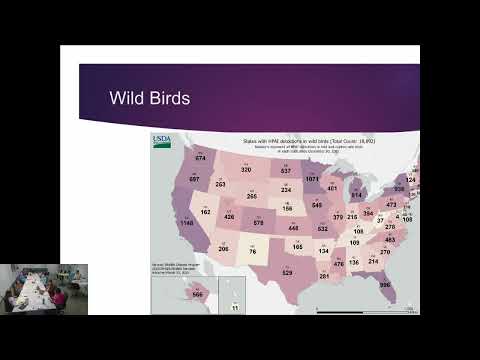
Dr. Jenn also summarized surveillance findings in wild birds: recent clusters of dead birds in several states were either confirmed or presumed to be HPAI, prompting concern that some strains may be more pathogenic in wild species than previously observed. He said migratory wild birds can spread virus particles in saliva and feces and that viral material can persist in water and frozen conditions, enabling wider dissemination.
On human risk, Dr. Jenn told the board that human infections remain uncommon because human airway receptors differ from birds’, and that most U.S. human cases have occurred in poultry workers after prolonged, unprotected exposures. “The cases we see in humans are usually poultry farm workers,” he said, and added that evidence for sustained human-to-human transmission remains limited.
The board followed with questions about the interval from infection to death in birds and about vaccines. Dr. Jenn said federal agencies are evaluating poultry vaccines and that human vaccine information in public sources is limited; he cautioned that vaccines may reduce disease severity in birds without fully stopping transmission. He also noted that a national stockpile holds doses for human use if needed but that effectiveness data are sparse.
In the same meeting Dr. Jenn reported on other communicable-disease trends. He said a measles outbreak in South Carolina involved about 1,000 cases concentrated in one county and reiterated the importance of childhood vaccination. He also reported a local rise in pertussis (whooping cough): county numbers rose to about 85 cases this season compared with typical seasonal counts in the low single digits.
Board members and staff discussed public messaging and prioritization of vaccines. Members asked whether recommendations could be tiered so that high-priority vaccines receive focused outreach; Dr. Jenn said such prioritization conversations are occurring at higher levels but that local education about core vaccines remains important.
The board did not take regulatory action on avian influenza at the meeting; the discussion focused on surveillance, prevention steps for agricultural stakeholders and public‑facing education. The board also noted upcoming Public Health Week (April 6–10) as an opportunity for outreach and vowed to continue monitoring state and federal updates.