Get Full Government Meeting Transcripts, Videos, & Alerts Forever!
Get email alerts on the Local Revenue Measures topic
No spam. Unsubscribe anytime.
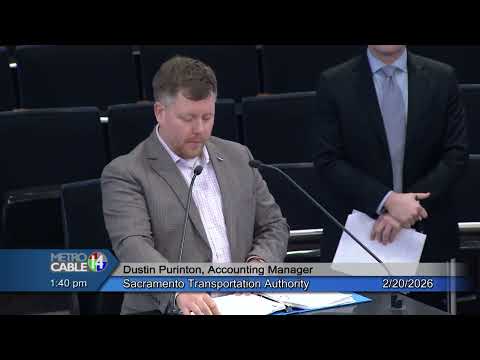
STA directs staff to pursue hybrid approach for abandoned‑vehicle fee reauthorization and to seek polling funds
Summary
The board directed staff to pursue a hybrid of pursuing a November 2026 reauthorization of the Sacramento Abandoned Vehicle Service Authority fee and additional work, and to seek jurisdictional contributions to fund polling (estimated $35,000–$40,000) to test ballot language and timing.
The Sacramento Transportation Authority on Feb. 20 directed staff to pursue a hybrid approach to the future of the Sacramento Abandoned Vehicle Service Authority (SASA), asking staff to prepare for a potential November 2026 ballot measure while also conducting polling and additional outreach to determine the optimal timing and ballot language.
Jennifer Dah, STA special programs manager, reminded the board that SASA was established under California Vehicle Code section 22710 in 1992 and that the DMV collects the fee and the state controller distributes revenue pursuant to Government Code section 9250.7. Staff said SASA collected about $30 million over 30 years (roughly $1.3 million per year on average) and recorded roughly 300,000 abatements in that period. The program effectively lapsed after an April 2022 sunset and a June 2022 ballot measure received 57.7% voter approval — short of the two‑thirds threshold required for what the board said is treated as a special tax under Proposition 26.
Staff presented three options: 1) end SASA and distribute remaining funds by formula; 2) pursue a November 2026 ballot measure to reauthorize a $1 per vehicle registration fee (which would require a two‑thirds vote) and conduct polling beforehand; or 3) delay a ballot measure and continue planning. Staff recommended pursuing options 2 and 3 together: advance the work now, perform polling to refine the ballot question and timing, but keep the option to postpone based on polling results.
Directors asked about household impact; staff said the proposal would be $1 per vehicle registration (roughly $2–$3 per household per year, depending on vehicles per household). Polling was estimated at $35,000–$40,000; staff proposed asking jurisdictions that historically benefited from SASA to contribute proportionally toward that cost.
A motion to direct staff to pursue a hybrid of options 2 and 3 and to seek jurisdictional contributions for polling was moved, seconded, and approved on roll call. Director Plucky Bomb and Vice Chair Hume recorded 'No' votes; the motion otherwise passed.
Next steps: staff will seek contributions from beneficiary jurisdictions to fund polling and will return to the board with polling results, recommended ballot language options, and a proposed timing decision based on the poll and jurisdictional input.