Get Full Government Meeting Transcripts, Videos, & Alerts Forever!
Get email alerts on the Housing Affordable topic
No spam. Unsubscribe anytime.
Brookline Housing Authority outlines Walnut/High plan to replace 100 public units with 181 affordable homes
Summary
The Brookline Housing Authority presented plans to demolish obsolete Walnut High public housing and rebuild in two phases to deliver 181 affordable units, pursue Passive House standards, and seek $7.5 million in town support; the Select Board heard details and will vote at a future meeting.
The Brookline Housing Authority (BHA) presented a two‑phase redevelopment of the Walnut/High public housing site in Brookline Village that would replace the existing 100 federal public housing apartments with 181 affordable units aimed at family households.
BHA Executive Director Michael Al told the Select Board the agency concluded a 2019 physical‑needs assessment found the 1962 buildings obsolete and that rebuilding — rather than rehabilitating — best meets long‑term safety and habitability goals. Project team members said the site plan uses a zoning overlay adopted under the MBTA Communities Act and would phase work to limit displacement.
Architect Nick Beeren said the design consolidates building entries into a Walnut Street plaza, orients community spaces to the street, preserves as many mature trees as possible and places structured parking under phase two to reduce fronting traffic. He described stepping building heights down the hill along High Street and designing town‑house scale frontages and ground‑floor residential doors to better relate to neighbors.
BHA project manager Amelia Youngstrom said the plan would increase the number of below‑market units to 181 over two phases, prioritize family‑sized units, and include sustainability measures: Passive House performance targets, electric building systems, and rooftop photovoltaic panels. She said BHA is pursuing state competitive funding; the pre‑application is expected in early November and the full application in February 2025, with award decisions potentially in summer 2025. If funded, demolition could begin in summer 2026 followed by phased construction.
On financing, Roger Blood of the Housing Advisory Board said town support under discussion totals $7.5 million — roughly 10% of the project cost — structured as a 50/50 blend from the Affordable Housing Trust and Community Preservation Act (CPA) funds. He described an advance‑and‑reimburse structure to allow the trust to forward funds and later be reimbursed by committed CPA dollars.
BHA emphasized tenant protections: a professional relocation firm will assist households and residents will have a right to return. The project team noted traffic constraints at Walnut and High, and said vehicle circulation would be routed into rear parking courts and structured parking, with a traffic study to be filed with the Planning Board.
Select Board members pressed the team on parking assumptions (the team said a 7.4 overall ratio and one‑for‑one replacement of existing resident parking), facade and material choices (subject to Planning Board review and community input), and the schedule for the board to consider Affordable Housing Trust commitments and a PILOT (payment‑in‑lieu) agreement. BHA said the Select Board will take votes on Town funding, pilot terms and fee waivers at a later meeting once departments have reviewed the requests.
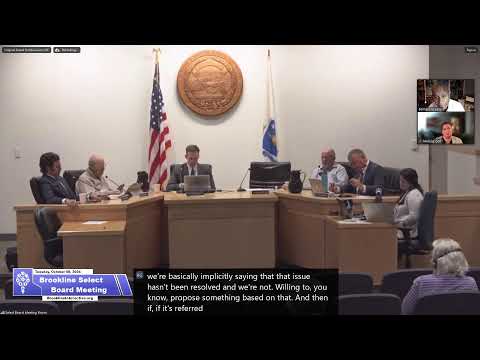
The presentation was informational; the Select Board did not vote on funding or PILOT terms at the Oct. 8 meeting and agreed to take the requests up at a future meeting so BHA can meet state application deadlines.