Get Full Government Meeting Transcripts, Videos, & Alerts Forever!
Get email alerts on the Education Enrollment topic
No spam. Unsubscribe anytime.
Rutherford County hears enrollment forecast as commissioners approve McFadden earnest‑money payment and charter true‑up
Summary
School leaders and consultant RSP told commissioners that ongoing residential building and population growth put Middle- and High‑school capacity under strain, prompting discussion of a future high school site (Lee Road) and funding options. The committee approved a $65,000 refundable earnest‑money payment for five properties bordering McFadden and a $175,854 charter-school true‑up.
Rutherford County commissioners heard an in‑depth enrollment and capacity briefing on Dec. 16 and approved two school‑budget amendments: $65,000 to cover refundable earnest money and appraisals for five properties bordering McFadden School, and $175,854 for the fiscal‑year 2024–25 charter‑school final true‑up.
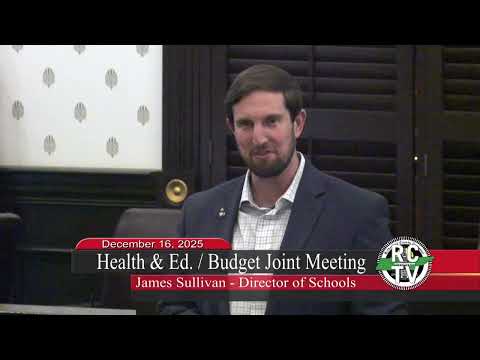
Dr. Jimmy Sullivan, the Rutherford County director/superintendent, described the $65,000 item as the first step in purchasing five privately held parcels that currently encroach on McFadden’s footprint. He told the committee the school board had placed the properties under contract to preserve the option to renovate or rebuild McFadden in coming years and confirmed the earnest money is refundable if the district chooses not to proceed.
“We put them under contract which gives us the ability to walk as well if the appraisals don't come in the way that we want,” Dr. Sullivan said, explaining the payment covers earnest money and appraisals. The Health & Education Committee moved the amendment forward to the Budget Committee by roll call vote.
The $175,854 true‑up was described by Dr. Sullivan as a state‑required adjustment to reconcile local revenue and student counts from the prior year; the district must use fund balance because final revenues are determined after the fiscal year closes. Commissioners approved that amendment as well.
Rob Schwarz, a consultant with planning firm RSP, then presented a multi‑page enrollment analysis and capacity study that tied population, housing‑unit growth and live‑birth cohorts to projected K–12 enrollment. Schwarz said RSP combines county and municipal planning data, ESRI market analytics, developer plats and on‑the‑ground tours to forecast short‑ and mid‑term student demand.
“The district has been creating and using data‑driven solutions to guide their decision‑making,” Schwarz told the committee, summarizing the presentation’s three objectives: explain the data, build commissioner confidence about requests that may follow, and highlight planning needs for continued development.
Key findings and implications
- Growth drivers: RSP documented large numbers of units built in the last decade (single‑family and multifamily) and 19,500 units identified in near‑term planning areas. The consultant said those developments are the primary factor behind rising school‑age population.
- Cohort and migration effects: RSP showed that cohort progression and inflow from Murfreesboro City Schools substantially increase middle‑ and high‑school enrollments in some zones. The presentation noted a recent October‑to‑October dip in kindergarten numbers attributed to the COVID birth cohort; consultants expect a rebound in subsequent years.
- Capacity pressure at secondary level: While the district’s systemwide utilization was presented as roughly 84% today, commissioners were shown that middle‑ and high‑school capacity in growth corridors — especially the Stewart’s Creek–Blackman–Smyrna corridor — will reach or exceed functional capacity within five years. The district and RSP signaled they expect to request capital funding for at least one new high school in the coming budget cycle.
- Site and timing: Dr. Sullivan and staff noted the Lee Road parcel as the district’s favored site for a future high school based on projected enrollment patterns near Stewarts Creek and Blackman; the district has not yet made a formal ask for design funds. Officials stressed the multi‑year lead time involved: roughly a year for design and two for construction is typical for a high‑school project.
Commissioner questions and county concerns
Commissioners engaged the consultant and district staff for more than an hour. Key topics included where money to pay for new schools would come from (county fund balance, reallocation from other funds, or debt issuance), how RSP’s forecasts incorporate city and county planning data, and whether the county is focusing too heavily on the northern growth corridor rather than long‑term, countywide patterns.
County finance (Michael) said the commission has options: draw from fund balance (with cash‑flow risks during summer months), reallocate from other internal funds, issue bonds or bond‑anticipation notes, or include costs in next year’s budget. Several commissioners emphasized cash‑flow concerns and urged caution about depleting the operating fund balance.
At one point a commissioner said they had heard from Rutherford County’s planning department that it had limited contact with the consultant; Rob Schwarz replied that RSP has documented conversations and meetings with the county and municipal planning offices, review of plats and site tours, and that those meetings are recorded in their process.
Next steps and follow‑up
Commissioners asked for additional briefings and deeper analysis of several items — including charter and voucher impacts, multifamily vs. single‑family yield rates, and reconciliation of building‑by‑building capacity numbers. RSP and the district agreed to follow up; commissioners invited RSP to return for additional conversation with county planners and to provide more granular reconciliations.
Chairman Dodd closed the meeting by noting the committees will revisit the budget amendments at their Jan. 8 session and tasked County Finance to present funding options for the McFadden earnest‑money step that protect payroll/cash‑flow while enabling the board’s contracting step.