Get Full Government Meeting Transcripts, Videos, & Alerts Forever!
Get email alerts on the Local Budget topic
No spam. Unsubscribe anytime.
Harrisburg reviews draft FY25 budget as county pay study, solid-waste rebid and Duke rates widen funding gap
Summary
Town staff told council at an all-day workshop that three large, mostly unavoidable cost increases — county law-enforcement salary study, a rebid solid-waste contract and higher Duke Energy street-lighting rates — together are driving millions of dollars in pressure on the draft FY25 budget.
Town of Harrisburg leaders spent an all-day budget workshop reviewing a draft fiscal 2025 budget that staff described as a “first draft” and not yet balanced.
Town staff opened the workshop by outlining the agenda and the priorities for the day: departmental deep dives, updates to capital projects and modeling for next steps in the tax-rate and fee exercise. The presentation identified three major changes since the last budget workshop that staff said will have the largest near-term impact on the town’s finances.
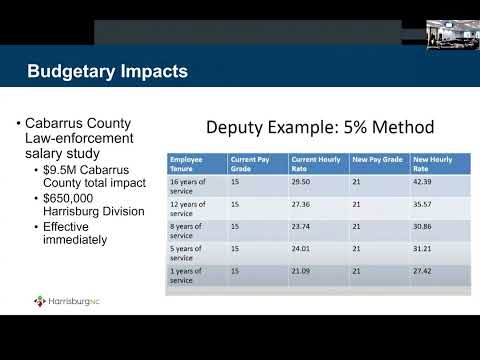
First, county commissioners adopted a Cabaris County law-enforcement salary study and made it effective immediately. Staff said that will increase Harrisburg’s contract cost with the county sheriff’s office by roughly $650,000 in the current budget year because the town pays the county wage rates for its contracted deputies.
Second, the town's solid-waste contractor rebid produced a nearly 32% increase compared with the previous contract and — according to staff figures presented at the meeting — will add about $450,000 a year to the town’s sanitation costs for garbage and recycling collection.
Third, Duke Energy won a multi-year rate increase that staff said will push some charges for residential customers modestly but will have an outsized effect on street-lighting costs. Staff noted the company received an initial 8.5% residential increase and an approved three-year, near-34% rise for street-lighting costs, with roughly 24% of that frontloaded. Those street-light expenses are embedded in the town’s operating model for road and corridor lighting, staff said, and must be covered from operating revenues.
Taken together, staff said the three items are the biggest drivers of the gap between their draft spending plan and available ongoing resources. The town’s revaluation produced an approximate $6 million shift in assessed value; staff said about $3.5 million of the town’s immediate needs are unavoidable contractual or statutory costs and that council faces decisions about how to use the remaining revenue. Staff emphasized the draft is not a formal tax-rate recommendation; council will consider rate options during upcoming council exercises and one-on-one briefings before the April adoption schedule.
Town staff walked council through options that would use a property-tax-based cut or increase, or substitute targeted fees to cover parts of the gap. Staff noted that a monthly solid-waste charge, for example, could be used to dedicate revenue to cover the contract increase if council prefers to separate sanitation funding from property-tax revenues. Staff presented model scenarios — ranging from modest fees to an $20 monthly charge — and the equivalent property-tax impact for comparison.
Presenters repeatedly emphasized that many capital projects are grant-dependent and timetables will change if grant awards do not arrive. Staff recommended council use the workshop and follow-up budget exercise to prioritize investments, set direction for the town manager and prepare a balanced budget for a public hearing and vote later in the spring.
The workshop included department presentations on policing, engineering and public works, parks, fire and training needs, finance, planning and other operations. Several departments asked council to consider targeted additions — notably police staffing requests tied to the county salary study and engineering requests for a GIS technician partially funded from enterprise funds — while other departments described multi-year capital plans that will require future funding decisions.
Next steps: staff will follow the council’s guidance in upcoming exercises and bring revised models, fee options and draft tax-rate scenarios for council consideration before the April decision that will produce a balanced recommended budget for public hearings.