Get Full Government Meeting Transcripts, Videos, & Alerts Forever!
Get email alerts on the Council Vacancy topic
No spam. Unsubscribe anytime.
Council vacancy candidates emphasize budget stewardship, public safety and oppose local participation in 287(g) enforcement
Summary
At interviews for a Green Tree Borough council vacancy, candidates Cara Marella and Mark Daffer prioritized the municipal budget, infrastructure and public-safety planning tied to PennDOT work; both said they would only pursue a 287(g) immigration-enforcement agreement if residents asked and Daffer said he opposed local participation outright.
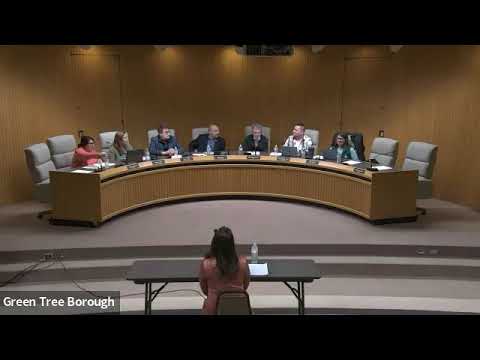
Two candidates for a vacant seat on the Green Tree Borough Council told council members and residents on the record that budget restraint, infrastructure repair and public-safety planning should guide the borough’s next two years, and that decisions about partnering with federal immigration enforcement must reflect local priorities.
Cara Marella, introduced by council as a long-time Arla Drive resident and local volunteer, told the mayor and council that her top priority would be the borough budget. “The budget would always be first because everything else stems from the budget,” she said, adding that she would avoid increases in residential taxes and pursue grant funding and careful prioritization of projects such as storm-sewer repairs and pedestrian safety tied to the I‑376 interchange project. Marella ranked the municipal swimming pool and Point Park field as high community priorities immediately below traffic and pedestrian-safety concerns.
Marella said she would focus her first six months on learning council processes and understanding 2026 goals so she could be assigned to projects that match her strengths. On resident communication, she emphasized timely, honest follow-up — responding quickly even when an answer is not yet available — and supported more workshops, upgraded meeting technology and targeted outreach where residents gather.
Mark Daffer, who described nearly 20 years as a borough resident and prior service on the civil service commission, said the borough’s most urgent leadership gap is a permanent police chief. “We haven't had a police chief in two years,” he told council, calling the vacancy a public‑safety concern as PennDOT projects and traffic detours approach. Daffer also urged the council to come to timely decisions on the pool and other concrete projects rather than delay indefinitely.
On a question about a 287(g) agreement — a federal program that can authorize local enforcement of certain immigration matters when a police department signs a partnership — both candidates said the council should treat the issue as a council-level, community-driven decision. Marella said she would bring it forward only if residents signaled it as a priority. Daffer said he did not see a role for the borough’s police in that program and strongly questioned the value of local participation, drawing on his experience in deportation-defense work.
Both candidates stressed constituent-driven decisionmaking: Marella said council decisions should reflect community needs; Daffer said elected officials should vote consistent with constituents’ preferences rather than personal views. On fiscal choices, both favored preserving residential tax rates where possible; Marella highlighted competitive bidding and grant-seeking, while Daffer suggested commercial taxation adjustments could raise necessary revenue without increasing residential burdens.
The interviews were exploratory: council established that it would not deliberate or vote on the appointment at the session and will consider the candidates at its March meeting. Residents present were allowed to ask follow-up questions; one attendee asked whether the borough would prioritize the 287(g) matter. Council will make the formal decision at its next scheduled meeting.
Provenance: The interview began with the meeting format and questions (meeting open and mayor’s introduction) and ran through public questions and candidates’ closing remarks. Topic coverage is drawn from the interview segments where candidates answered council and resident questions.