Get Full Government Meeting Transcripts, Videos, & Alerts Forever!
Get email alerts on the Rifle Hunting Policy topic
No spam. Unsubscribe anytime.
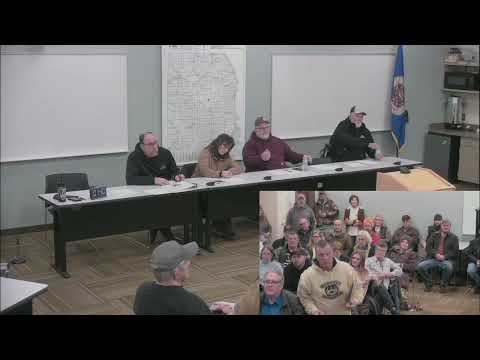
Houston County public hearing draws residents debating whether to allow rifles for deer hunting
Summary
Residents and hunters gave hours of testimony at a Houston County public hearing, sharply divided over whether to opt out of state rules to allow rifles for deer hunting; opponents cited safety, ricochet and youth risks, while supporters cited harvest efficiency and hunter recruitment. No vote was taken; a second hearing is set for March 3.
Houston County residents packed a public hearing to weigh whether the county should opt out of a statewide change allowing rifles for deer hunting, with testimony sharply split between safety concerns and arguments for greater hunting efficiency.
Clayton Johnson, a resident of Blackhammer Township, opened the public comment portion opposing rifles, saying he was a hunter, not a killer: "I'm not a deer killer. I'm a deer hunter," and urging commissioners to "maintain Houston County as a shotgun zone" for safety reasons. Multiple speakers recounted family and community safety concerns, misidentification risks, and the possibility of bullets traveling beyond property lines.
Several commenters cited technical or historical context. Gary Van Dlin referenced the origin of the 1942 law and told commissioners the restriction was originally a herd-management tool rather than a safety regulation: "The original law...wasn't a safety tool." Luke Anstead used online parcel mapping to show that, from some ridge-top positions, common rifle cartridges could potentially cover dozens of neighboring parcels; he also said Houston County saw a 9% increase in deer harvested from 2024 to 2025.
Opponents emphasized youth and bystander safety. Marissa Pearson of Calonia said she did "not support allowing rifles to be used to harvest deer," citing concern for her son and other young hunters and warning that greater range "decreases safety" because not everyone will carry binoculars or carefully scan what is beyond a target. Kay Cross framed the question as one of sportsmanship and target identification, saying, "The risk is too great," and cited examples of accidental shootings raised in her research.
Supporters argued rifles can improve harvest effectiveness and help recruit and retain hunters. Steve Karns and others pointed to Wisconsin data they said showed no measurable increase in accidents after that state allowed rifles; Dean Ellingsson said rifles are "much more efficient" and noted elevated stands and downward shots can make many rifle shots safe. Several speakers recommended compromise options such as limiting allowed cartridges to lower-powered, "straight-wall" rounds rather than an unrestricted allowance of high-powered rifles.
Technical points came up repeatedly. Dan Vester recounted combat-era ricochet observations to argue that bullets can ricochet unpredictably; other commenters cited the Pennsylvania study that compared certain shotgun and rifle loads and emphasized that study design and cartridge selection affect outcomes. Firearm-safety instructors present urged stronger training and emphasized the core rule to "know your target and beyond," and one speaker noted the availability of non-lead ammunition as a mitigation for scavenger-lead concerns.
A staff member clarified enforcement limits should the county adopt local cartridge or caliber restrictions: the Minnesota Department of Natural Resources (DNR) will not enforce modifications to state regulations; local enforcement of any added restrictions would fall to the county sheriff. The staff member and commissioners also reminded attendees this is the first of two required public hearings: a second hearing is scheduled for March 3 at 6:00 p.m., and any county decision must be completed before the April 1 deadline.
No formal action on the substance of rifle allowances was taken at the meeting; the commission took only procedural votes to open and close the public hearing and to adjourn. Commissioners will consider public testimony at the scheduled follow-up hearing before deciding whether to opt out or leave the statewide rule in place.
The county made available written comments submitted by some speakers; commissioners said the public may return for the March 3 hearing to present additional testimony or follow-up information.