Get Full Government Meeting Transcripts, Videos, & Alerts Forever!
Get email alerts on the Environment topic
No spam. Unsubscribe anytime.
Green Ridgewood urges regional flood strategy as countywide risk climbs; village readies grant push
Summary
Green Ridgewood presented its 2025 accomplishments and 2026 priorities to Ridgewood’s council, calling for regional collaboration on Saddle River watershed flood mitigation and a coordinated grant application due June 7. The group also highlighted food‑scrap expansion and a review of gas‑powered leaf blowers.
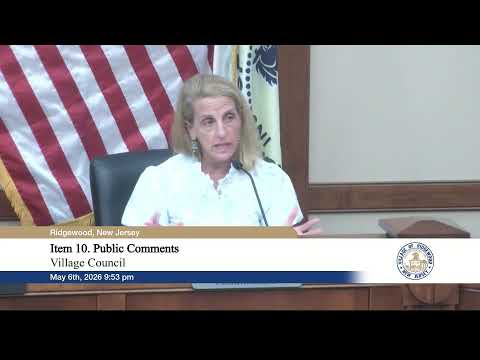
At the May 6 council workshop Green Ridgewood summarized last year’s work and pressed the village to join a regional approach to flooding, citing a Columbia University student study and countywide exposure estimates.
"Bergen County is the number one at‑risk county in the United States for flood risk," David Refkin told the council, summarizing findings that put about $800 million of at‑risk real estate in Ridgewood and some $72 billion countywide. Refkin said Green Ridgewood and neighboring towns are coordinating a second round application to New Jersey’s climate resiliency grant program (deadline June 7) to fund regional mitigation planning and consultant teams.
Refkin outlined a three‑pronged agenda: 1) organize town‑to‑town collaboration across the Saddle River watershed, 2) improve emergency preparedness and park stewardship for Saddle River County Park, and 3) pursue grant funding to underwrite consultant teams and community‑based organizations. He said earlier applications were unsuccessful but that local coordination and consistent town responses should strengthen the next submission.
On other items, Green Ridgewood urged the village to review two‑stroke gas leaf blowers citing noise and emissions examples from Maplewood and Montclair, and described progress on an expanding food scrap pilot (from 300 to 800 homes and additional drop‑off sites) to comply with a new state law requiring substantial food‑waste reduction by 2035.
Green Ridgewood requested village coordination on grant packaging and encouraged including Ridgewood Water’s drought‑and PFAS‑treatment innovations in future sustainability certifications. Council members and staff signaled support and noted coordination with Bergen County, NJIT researchers, and regional nonprofit partners would follow.
What happens next: Ridgewood will help organize town responses for the new resilience grant cycle; Green Ridgewood and staff will continue technical work on leaf blower policies and food scrap expansion.