Get Full Government Meeting Transcripts, Videos, & Alerts Forever!
Get email alerts on the Clinton Epstein Deposition topic
No spam. Unsubscribe anytime.
Clinton testifies to House Oversight: denies knowledge of Epstein trafficking, recounts limited foundation travel on Epstein plane
Summary
Former President Bill Clinton testified before the House Committee on Oversight and Accountability about his past interactions with Jeffrey Epstein and Ghislaine Maxwell, said his contact was limited to foundation travel and fundraising, denied witnessing sexual abuse, and called for full release of records and stronger anti‑trafficking measures.
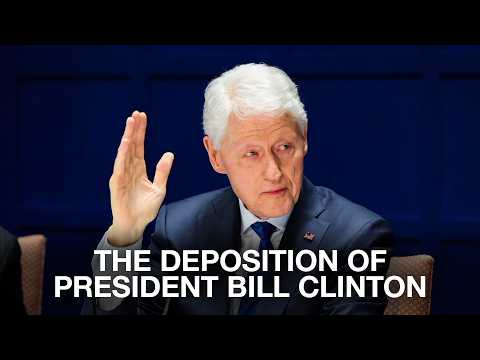
Former President William Jefferson Clinton testified Feb. 19, 2026, before the House Committee on Oversight and Accountability in a deposition about his contacts with Jeffrey Epstein and Ghislaine Maxwell.
Clinton acknowledged taking multiple trips on Epstein’s airplane in the early 2000s to advance Clinton Foundation work on AIDS and post‑disaster reconstruction, but he repeatedly denied any knowledge that Epstein or Maxwell were trafficking or sexually abusing minors. “I never saw anybody do anything wrong,” he said. Clinton told the committee he believed his last flight with Epstein was in 2003 and that he first learned of Epstein’s criminal conduct when Epstein was prosecuted in 2008.
The committee displayed flight logs, passport documents, photographs and email threads collected in Department of Justice and press releases. Clinton confirmed he was pictured with Epstein in a New York photograph he had not previously seen and identified a passport alias included in DOJ exhibits as appearing to be Epstein, but he said he had never seen the passport document before it was shown in the deposition. He also confirmed his Secret Service detail accompanied him on trips cited in the flight logs.
Asked about several named people listed in committee exhibits, Clinton said he recalled Larry Summers arranging an introduction because Epstein offered to fly Clinton and his staff in support of foundation work. For many other names on the committee’s checklist he said he had no recollection of discussing Epstein or Maxwell with them.
On survivor allegations that place Clinton at locations such as Epstein’s Little St. James island, Clinton said he was not there and called specific claims he could not verify "not true." When counsel read portions of Ghislaine Maxwell’s July 2025 DOJ interview in which she said she had been invited to Chappaqua, Clinton said he did not remember whether Maxwell had visited the Clintons’ Chappaqua home and that visits sometimes occurred in connection with his wife’s public events.
Clinton repeatedly told the panel he wished he had known more at the time. Asked about a widely circulated photograph showing him receiving a massage on an airport trip, he said he regretted not knowing then what investigators later found about Epstein’s recruiting methods and said, “I wish Shante had told me.”
Clinton urged the committee and the Justice Department to release records that can be disclosed, protect victim privacy where necessary, and to strengthen reporting and follow‑up systems and services for trafficking victims. “The record should be released,” he said, adding that victims deserve both transparency and resources for healing.
The deposition lasted multiple hours and alternated between majority and minority questioning. Clinton was sworn in at the start of the session and was represented by personal counsel on the record. Committee members introduced dozens of exhibits, including flight manifests, contemporaneous correspondence, press articles and parts of the DOJ investigative files. The hearing closed with Clinton reiterating that he had tried to assist the committee and urging bipartisan work to prevent trafficking in the future.