Get Full Government Meeting Transcripts, Videos, & Alerts Forever!
Get email alerts on the Land Conservation topic
No spam. Unsubscribe anytime.
Larimer County reports 64,232 acres conserved, $94 million in annual ecosystem services under climate plan
Summary
County staff told commissioners the natural-resources component of the Climate Smart Future Ready plan has conserved 64,232 acres to date, is about 60% of the way to a 24,000-acre-by-2043 target, and estimates conserved lands deliver roughly $94 million per year in ecosystem services; staff also outlined restoration, code changes and outreach steps.
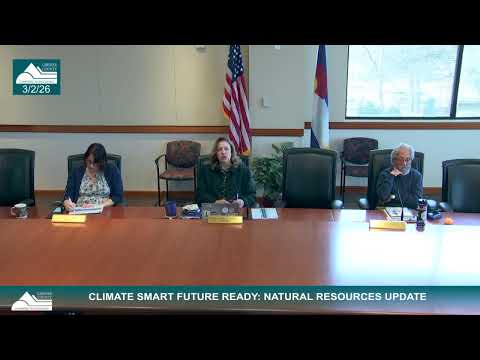
Larimer County staff updated the Board of County Commissioners on March 2 on the natural-resources portion of the Climate Smart Future Ready plan, reporting progress on land conservation, habitat restoration and program outreach.
Megan Fenkin, natural-resources champion in the county's Natural Resources Department, told commissioners the county has conserved 64,232 acres to date — "exactly 14,232 acres" added since the 2017 baseline of 50,000 acres — and that progress equates to roughly 60% of the additional 24,000-acre goal set for 2043, when the county's open-space preservation tax is scheduled to sunset. "We're well on track there," Fenkin said.
Fenkin also cited a valuation tool from the Colorado Natural Heritage Program that staff use to estimate ecosystem services provided by conserved lands. Using 2025 data, she said, those lands return an estimated $94 million per year in services such as water filtration, carbon sequestration and other benefits that reduce future public costs.
The presentation outlined several active and planned actions on county-owned open spaces: targeted restoration projects (about 23 acres restored over the last five years and roughly eight acres restored in 2025), planned larger restoration projects in the next two years, and ongoing fence conversions to improve wildlife connectivity. Fenkin said the county has removed or converted about three miles of fence per year, naming recent work at Horsetooth Mountain Open Space, Eagle's Nest and Canyon Edge as examples.
Staff described a county metric intended to limit conversion of native vegetation on open-space properties to no more than 5% of total acreage; Fenkin said the current converted share is about 3.5% and that upcoming cropland restorations at River Bluffs and Red Mountain open spaces should reduce that figure.
Fenkin said county staff have worked with the Colorado Water Conservation Board to nominate priority stream reaches for instream-flow protection and species recovery work, citing a reach in the Poudre Canyon (East Roaring Creek area) under consideration for greenback cutthroat trout recovery in 2025.
Commissioners asked about volunteer involvement and implementation. Fenkin replied that smaller restoration tasks — willow stake plantings, fence conversions and volunteer plantings — are often supported by volunteers, while larger river-restoration projects require contractors. Commissioners also raised drought and soil-health concerns; staff said a county water team is focused on drought planning and municipal–agricultural water relationships and noted transfer-of-development-rights work will incorporate soil-health and water nexus considerations.
On regulatory work, Fenkin said wildfire-resiliency best practices were added to the land-use and building codes in 2022 and that the planning commission adopted additional wildfire-resiliency code amendments in 2025; she also referenced Colorado model electric-ready and solar-ready code elements that have been integrated in related efforts.
Outreach and metrics were another focus. Heidi Pruz of the county offices of sustainability and climate said the presentation previewed roughly 10 remaining updates to the Climate Smart Future Ready dashboard and announced a public celebration event on April 2 to present progress. Staff said Extension set a goal of at least 20 site visits per year to track adoption of soil-health practices; staff reported conducting 20 site visits in 2024 and 29 site visits in 2025 and described soil-health demo events for producers.
Staff identified forthcoming items for commissioners' calendars: the updated dashboard and associated report (with additional cost–benefit detail, including work to frame the "cost of doing nothing") and a multi-jurisdictional hazard mitigation plan with FEMA that staff said is expected to be completed in August or September of the year.
The work session closed with commissioners thanking staff for the update. No formal votes or motions were taken during the presentation; the board adjourned at about 11:42 a.m.