Get Full Government Meeting Transcripts, Videos, & Alerts Forever!
Get email alerts on the Elementary School Consolidation topic
No spam. Unsubscribe anytime.
Wausau School District board approves task force's "bundle one" to consolidate elementary schools
Summary
The Wausau School District board voted to implement the elementary task force's preferred plan ("bundle one") in 2025-26, a package of consolidations and repurposings aimed at addressing declining enrollment, a projected operating deficit and roughly $25 million in deferred maintenance. The plan includes repurposing Lincoln as a 4K academy and closing several small, low-capacity schools.
The Wausau School District board voted on Jan. 8, 2025, to approve the elementary task force's recommended facility plan, known as "bundle one," directing district administration to implement the changes in the 2025-26 school year after a voice vote.
Mark Roers, the task force facilitator, told the board the group's work was driven by three converging trends: roughly 1,100 currently empty elementary seats across 13 schools (projected to rise toward about 1,300 if no changes are made), an annual operating deficit projected at about $2 million'$3 million beginning around 2027, and nearly $25 million in deferred maintenance across elementary facilities. "It's not necessarily a happy message but it is a message toward sustainability for the district going forward," Roers said.
Bundle one combines several one-to-one consolidations and a 4K reorganization. In the package presented to the board, Huitt Texas would close and its students move to Riverview Elementary; Hawthorne Hills would close with southern attendance-area students shifted to John Marshall and northern to Franklin (4K students at Hawthorne Hills would have placement options); Grant would close and shift students to Jefferson; and Lincoln would be repurposed to serve as a West-side 4K Academy while other 4K functions consolidate on the east side at Riverview. Roers said these moves would raise districtwide functional utilization to about 89'90% (up from approximately 70% today) and keep most students within two miles of their receiving schools.
On finances, Roers said the bundle would avoid roughly $4 million in near-term deferred maintenance on buildings taken off the district's inventory, and project an operating-cost reduction (excluding additional busing) of roughly $400,000'$500,000 per year after a multiyear transition and natural attrition; staff-expense reductions were estimated at $1.6'$1.8 million annually after attrition. He also flagged implementation costs and trade-offs: several receiver schools would need air-conditioning upgrades (Franklin and John Marshall were named), and consolidations would require additional buses (an estimated six to seven more routes).
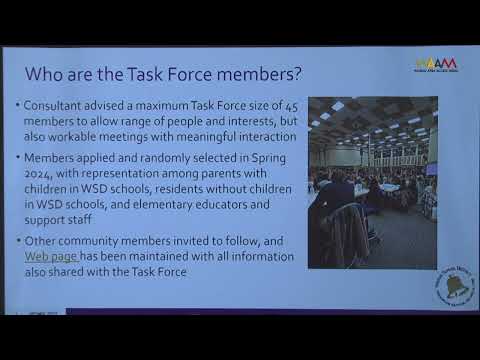
The task force used five evaluation criteria to reach its recommendation: fiscal responsibility; efficient building utilization; maintain educational opportunities; minimize student impact; and keep students close to school. Roers said the task force conducted about 10 full meetings plus numerous small-group discussions, produced a 96-question Q&A document for the public, and considered 10 distinct consolidation options before bundling its preferred set.
Board members who spoke during the discussion generally praised the task force's process and data-driven approach and expressed support for bundle one. One board member said passage would help demonstrate fiscal stewardship to voters in advance of any future referendum. Administrators committed to further work on attendance-area boundaries, staff transition planning, and building improvements before implementation.
John Huntington, a Wausau resident who spoke during public comment, urged a more aggressive long-term approach to consolidation, saying he favored reducing the district to as few as six elementary buildings to produce deeper long-term savings. The board acknowledged that future consolidation options could be revisited as demographics evolve.
A board member moved to adopt the bundle-one recommendation for implementation in the 2025-26 school year; another board member seconded. The board carried the motion by voice vote. The board then moved to adjourn.
What happens next: district staff will develop detailed attendance-area maps, refine the staffing transition plan (with an emphasis on using attrition where possible), and present implementation steps and timelines to the board. The board also identified the possibility of preparing a referendum to address facility and capital needs as one follow-up path.
Sources: presentation and discussion at the Jan. 8, 2025 special meeting of the Wausau School District board; remarks by task force facilitator Mark Roers; public comment by John Huntington.