Get Full Government Meeting Transcripts, Videos, & Alerts Forever!
Get email alerts on the Accessible Outdoors topic
No spam. Unsubscribe anytime.
Creator of Disabled in the Wild urges practical planning, adaptive gear and better site info for disabled outdoor recreation
Summary
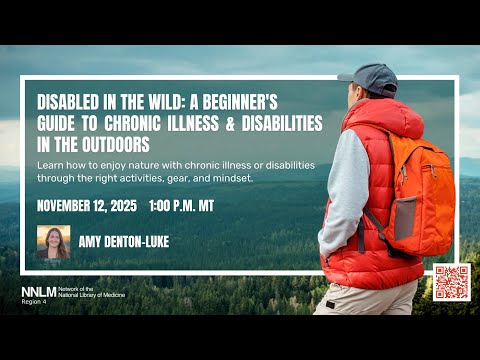
Amy Dunenluke, creator of Disabled in the Wild, told an NNLM Region 4 webinar that people with chronic illness and disability can enjoy the outdoors with planning, appropriate mobility aids or rentals, knowledge of site features, and realistic pacing and recovery.
Amy Dunenluke, creator of the blog and channel Disabled in the Wild, told a National Library of Medicine Region 4 webinar that people with chronic illness and disability can continue to enjoy outdoor recreation if they plan for their bodies’ needs, choose appropriate gear, and use accurate site information.
Dentonluke, who described living with chronic leg pain, fatigue and cognitive dysfunction, said mobility aids and adaptive equipment are tools that increase access. "Mobility aids exist to support our bodies the way they need to be supported and help us continue living our lives the way we want to live," she said, adding that aids need not be seen as a loss but as freedom.
Why it matters: Many public information sources lack the detail disabled people need to decide whether a trail, park or beach will work for them. Dentonluke urged attendees to look for specific site features — parking (including van-accessible stalls), location of restrooms, surface material, path width, benches with back support and clear signage — and to double-check official sites with recent photos and local reviews.
Practical steps and gear Dentonluke recommended tailoring activities to one’s energy and mobility: shorter flat trails and wildlife refuges for moderate levels, and low‑energy options — driving scenic routes, picnics, or backyard nature — for days with higher symptoms. For many people, adaptive sports remain possible where local nonprofit rental programs exist. She cited the Montana Assistive Technology Program as an example of a place that lends mobility and adaptive gear, often without fee and sometimes for extended loan periods.
She described personal equipment that helps her outdoors: lightweight forearm crutches (she referenced brands she uses), a tall narrow backpack that avoids elbow contact, a portable stool for quick rests, hand wipes and a dry bag to protect medication. For people with bladder or menstrual needs she suggested discreet supplies that reduce discomfort and the need to carry out used material.
Finding reliable site information Dentonluke advised starting with official agency pages (state parks, Fish, Wildlife and Parks or departments of natural resources, U.S. Forest Service) and supplementing with recent blogs, Google reviews and satellite view on Google Maps. "You can never fully know what a site is like until you get there, but it can be helpful to look it up first to try to be prepared," she said, recommending a backup plan if a site proves unsuitable.
Safety, pacing and recovery Dentonluke shared examples of near-misses — becoming disoriented, running out of cell service, and fainting — to underline the importance of precautions: go with companions when practical, tell others where you will be and what support you might need, carry an emergency beacon or offline maps, wear bright clothing, and plan rest before and after outings. "Taking breaks periodically — sitting down to rest for five to ten minutes every hour — is a really good way to check in with yourself," she said.
Resources and next steps The webinar also highlighted National Library of Medicine resources such as MedlinePlus, PubMed and ClinicalTrials.gov for health information and research context. Dentonluke said she will post the talk transcript and a condensed resource list on her site and encouraged attendees to contact state natural resources agencies to ask for accessibility improvements or to learn about available adaptive equipment.
The session closed with a short Q&A and links to the NNLM Region 4 webpage for future webinars and continuing education credit information. Slides and a captioned recording will be shared with registrants when they are available.