Get Full Government Meeting Transcripts, Videos, & Alerts Forever!
Get email alerts on the Data Privacy topic
No spam. Unsubscribe anytime.
Rep. Elkins proposes data-broker registry to help Attorney General enforce privacy law
Summary
Lawmakers heard testimony on House File 4456, which would add a data-broker registry to the Minnesota Consumer Data Privacy Act so the Attorney General’s office can better identify companies that buy and sell Minnesotans’ personal data. Witnesses debated scope, exemptions and how fees and enforcement would work.
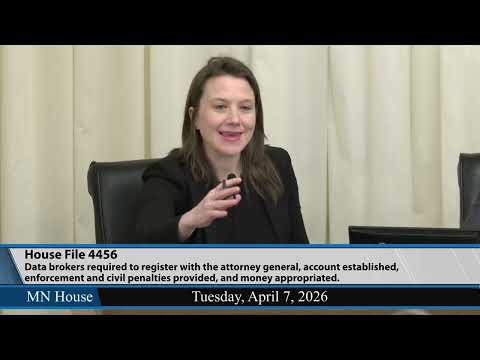
Representative Elkins introduced House File 4456 on April 7, proposing a data-broker registry to sit alongside the Minnesota Consumer Data Privacy Act so the Attorney General’s office can identify entities that buy and sell Minnesotans’ personal data.
"It adds a section to the back end of the Minnesota Consumer Data Privacy Act to establish a data broker registry," Representative Elkins said, describing the registry as modeled on laws in California, Texas, Oregon and Vermont and intended to give the Attorney General better tools to locate companies that may require enforcement attention.
Assistant Attorney General Sarah Doctor, Consumer Protection Division, said the registry would be "an incredibly useful tool to assist the office of the Minnesota Attorney general" and could also help consumers find who to contact to request deletion or correction of sold data. "This tells them to contact" the relevant entity, she said.
Industry witnesses urged clearer exemptions. Zachary Taylor of the Consumer Data Industry Association said that some companies and data flows are already governed by federal laws such as the Fair Credit Reporting Act and that a mismatch between those exemptions and a state registry could confuse consumers. Taylor warned that requiring registration by entities governed by other statutes could mislead Minnesotans about their rights and the remedies available.
Committee members asked whether the registry would address surveillance pricing and whether a national or multi-state registry might reduce filing burdens. AAG Doctor said the bill is "relatively narrow" and intended to create visibility for entities that do not have a direct relationship with consumers so Minnesotans can better exercise privacy rights granted under state law.
Lawmakers also discussed fee-setting for registry maintenance and the ability of the Attorney General to reach firms that transact business with Minnesotans even if they are offshore; witnesses described fees intended to recover operating costs and said jurisdictional enforcement depends on contacts with Minnesota.
The committee adopted an author's amendment to the bill by voice vote. The sponsor and witnesses said they would continue working with stakeholders to refine exemptions and the bill's interface with existing federal rules.
The committee did not record a final referral on the bill during this meeting; members sought further fiscal and technical detail as the measure moves through committee processes.