Get Full Government Meeting Transcripts, Videos, & Alerts Forever!
Get email alerts on the Historic Cultural Element topic
No spam. Unsubscribe anytime.
Special Historic Preservation Commission holds study session on Sonoma City's historic and cultural resources element
Summary
City planning staff and local stakeholders reviewed a draft Historic and Cultural Resources element for Sonoma City's general plan, discussing terminology, tribal cultural resources, archaeological sensitivity mapping and incentives; no quorum was present, so the session produced recommendations but no formal actions.
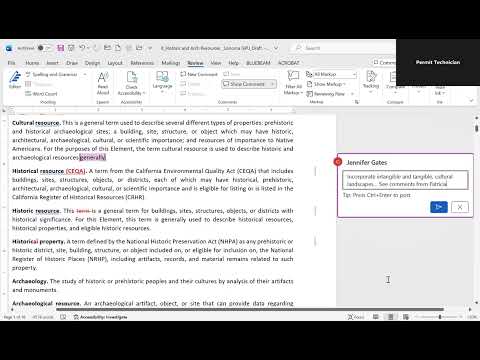
The Special Historic Preservation Commission convened a study session to review a draft Historic and Cultural Resources element for Sonoma City’s general plan. Chair opened the meeting but noted, "we do not have a quorum, but that's okay," and said the session would be used to gather stakeholder input; no formal actions were taken.
Staff told attendees the element is optional but important as a policy document to guide code updates and enforcement over the next 20 years, and that consultants prepared the draft with subconsultants focused on historic resources and archaeology. "The point is to set the big picture and then implement through our code," staff said, explaining the city wants council adoption of the element before pursuing ordinance changes.
Stakeholders and state staff participating included Noah Stewart, cultural resources program manager for the Bay Area District of California State Parks, and Peter Meerhoff of the Sonoma Valley Historical Society. Stewart and others pressed for clarity on key terms in the draft, especially use of "historic" versus "historical," and recommended aligning the document with established state definitions while also including language citizens would recognize.
Participants urged the element to recognize both tangible and intangible resources and to treat cultural landscapes (for example, the downtown plaza) separately from individual buildings. One stakeholder described a local neighborhood historically called St. Francis Place, citing its protected marsh and a community vineyard as examples of intangible cultural associations that the element should capture.
The group discussed tribal cultural resources at length. Staff said the draft intentionally uses the term "tribal cultural resources" to reflect tribal perspectives and noted those resources can be intangible (for example, sacred places) and are sometimes handled differently from archaeological sites. Noah Stewart and others advised the commission that archaeological and tribal sites are often treated as confidential; staff said the plan will include an internal sensitivity map "that will be internal only" to guide review of projects without exposing precise locations publicly.
Participants debated whether paleontology should remain with archaeological sensitivity or be placed in a separate section; the staff indicated paleontology would be pulled out of the tribal/archaeological section for clarity. Staff described sensitivity-level criteria (proximity to known sites, degree of ground disturbance and whether a location is highly disturbed) and explained different sensitivity levels would trigger different review requirements for projects.
On tools and incentives, staff highlighted adaptive-reuse policies (for example, allowing a wine tasting room in a ground-floor commercial use while retaining upper-story residences) and discussed potential incentives such as parking waivers, fee modifications and other zoning adjustments. The Mills Act was discussed in general terms; staff noted the program provides tax incentives that typically benefit more recent property purchasers due to Prop 13 and that broader incentive options would be explored with the commission.
Stakeholders asked that the city consider more direct support for the Sonoma Valley Historical Society and other local heritage organizations, noting limited local funding for museums and programming. Staff said the city has initiated historic-context statements and a plaza cultural-historic landscape survey and will fold those results into the general plan element.
Staff described next steps: edits collected during the session will be forwarded to consultants to assemble the full general plan and an environmental impact report, which staff said would be released for public comment for roughly 45–60 days; staff also plans additional commission briefings during that period. The chair adjourned the meeting at 4:05 p.m.
The session produced policy clarifications and drafting guidance for the element but, because there was no quorum, there were no votes or formal actions recorded.