Get Full Government Meeting Transcripts, Videos, & Alerts Forever!
Get email alerts on the Education CIP topic
No spam. Unsubscribe anytime.
County committee backs removing turf funding and urges reallocating $34.1M to HVAC and health-and-safety in MCPS CIP
Summary
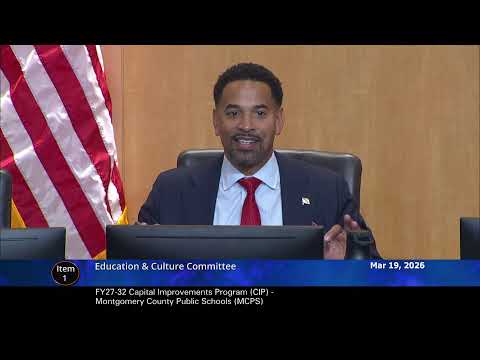
At a Montgomery County Council education committee session, members reviewed MCPS’s six-year capital plan, concurred with many nonrecommended reductions, voted 3-0 to delay Cold Spring elementary by two years, and signaled they want the $34.1 million the executive removed for artificial turf reallocated toward urgent HVAC and health-and-safety work; MCPS will consult its board and return with options before full council reconciliation.
The Montgomery County Council's education committee spent its session scrutinizing the Montgomery County Public Schools (MCPS) six‑year capital improvement plan and pressing for more funding for building health and safety, particularly HVAC work.
MCPS capital budget manager DJ Connelly reviewed enrollment and capacity assumptions that shaped the district’s requests and explained how rising construction costs and lower-than-expected enrollment have changed project needs and timing. Connelly said the district is still contending with a large backlog of facility needs, adding, "We can ask for $100 million a year and we would still be playing catch‑up." The committee repeatedly tied that backlog to urgent health concerns such as mold and indoor‑air quality.
Why it matters: committee members framed the debate as a choice between new or upgraded athletic and outdoor facilities and immediate health-and-safety investments for students and staff. Councilmember Kristin Mink argued the HVAC needs are a higher priority, warning that failing to address air‑quality and heating/ventilation systems creates moral and liability risks for the county.
Key decisions and requests
- The committee recorded a 3‑0 vote to change a previously proposed three‑year deferral of the Cold Spring Elementary replacement to a two‑year delay, with construction now scheduled to start in FY32. Staff said the technical estimate of the schedule change would add roughly $28.7 million in the six‑year accounting, depending on the timing chosen. (Committee action recorded during the meeting.)
- Members signaled formal concurrence with a series of other project recommendations and nonrecommended reductions under "scenario A," including approvals to leave several projects on their current schedules (for example, Burtonsville OMA/Driscoll projects and the Woodward reopening) while deferring or removing other proposed projects.
- The committee expressed a clear preference that the $34.1 million the county executive removed from the proposed CIP by cutting artificial‑turf installations be reallocated to HVAC and other health-and-safety priorities. Office of Management and Budget staff and committee analysts said OMB calculated the $34.1 million by substituting natural‑grass capital assumptions for the synthetic‑turf installations MCPS originally proposed, and they cautioned that the council must work with MCPS and the school board to confirm how any reallocation could legally or practically be accepted.
MCPS presentations and project details
MCPS staff walked the committee through multiple projects: near‑completion replacements (e.g., Burtonsville OMA/Driscoll), the Woodward reopening (on track for August 2027), Northwood additions, and a new Sligo Creek elementary replacement estimated at about $70.5 million. Staff also described the district’s umbrella “major capital” projects and explained that prioritization, project deferrals and pushing expenditures beyond the six‑year window are tools being used to close a budget gap tied to differing bond‑capacity assumptions between the executive and council.
Turf vs. grass: numbers and tradeoffs
MCPS and OMB presented a direct comparison of synthetic turf and natural grass. MCPS staff noted synthetic turf has far higher upfront capital costs but far greater usable hours (an MCPS exhibit estimated roughly 450,000 hours over 10 years for synthetic turf versus 69,000 for natural grass) and lower annual operating costs; OMB modeled replacing synthetic turf projects with natural‑grass alternatives to produce the $34.1 million reduction in capital spending.
Council members who pressed to reallocate the money emphasized equity and safety concerns. Councilmember Shebra Evans urged outreach to communities that expect turf at certain schools, calling turf an equity issue for students who want comparable facilities. Several members, including Mink and Chair Will Jawando, said the committee’s priority is to give HVAC needs the best chance of survival in the reconciliation process.
Next steps
The committee asked MCPS to consult the superintendent and the school board about the committee’s suggestion that the $34.1 million be shifted to HVAC/health‑and‑safety work and to return with a clearer path for how that could be implemented, including any legal or board‑authorization constraints. Staff reiterated that final reconciliation decisions will occur before the end of May and that the full council will consider committee recommendations at a later meeting.
The committee adjourned after directing staff to capture the committee’s preferences in the reconciliation tracking system and to return with the requested clarifications for the full council’s review.