Get Full Government Meeting Transcripts, Videos, & Alerts Forever!
Get email alerts on the Legislative Rezoning topic
No spam. Unsubscribe anytime.
Commerce City staff preview city‑wide legislative rezonings, outline outreach and timeline
Summary
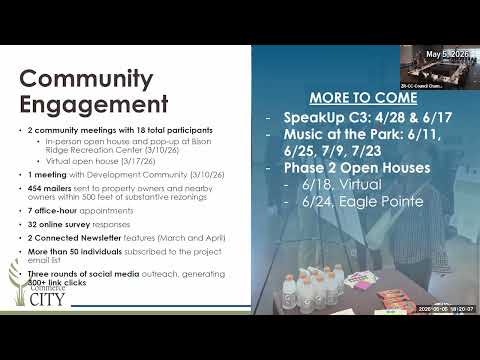
Commerce City staff presented a phase‑by‑phase plan to apply the 2025 Land Development Code across the city, described outreach (450 mailers, 32 survey responses) and said PUD overlays will remain while underlying base zoning is assigned; staff highlighted limits to changes where PUD entitlements already exist.
Commerce City staff on a joint study session described a city‑initiated legislative rezoning to implement the 2025 Land Development Code and align zoning with the 2045 Comprehensive Plan. Deputy Director Heather Vidlock said the rezoning will assign underlying base zones while preserving existing PUD overlays, then move through Planning Commission in September and two City Council readings in October and November.
The staff presentation framed the effort in four types of rezonings: one‑for‑one code conversions where zones carry over, cleanup of patchwork zoning, assigning underlying base zoning beneath long‑standing PUD overlays, and policy‑driven changes guided by character‑area and corridor maps. “The new land development code is only applicable to properties that are undergoing annexation and zoning right now… they will apply across the board to the whole city once we complete this legislative zoning process,” Vidlock said.
San Han, the principal planner, updated commissioners on the Transit‑Oriented Communities analysis for the 72nd & Colorado area. Staff reported a housing opportunity goal of about 1,685 units established with the Colorado Department of Local Affairs and a preliminary zoning capacity under a one‑to‑one conversion near 258 units — a gap that shaped planned engagement for phase two.
Allison Olsen summarized phase‑one outreach in the northern neighborhoods: staff mailed notices within 500 feet for substantial rezonings (roughly 450 mailers), held in‑person and virtual open houses, offered office hours and developer meetings, and collected 32 online survey responses. Staff said they updated the survey to include a clearer legend defining zoning acronyms (for example, C1 as local commercial, C2 as general commercial) and will add links to code definitions to help residents understand what different districts permit.
Discussion with commissioners focused on how PUD entitlements interact with the rezoning. Staff emphasized that PUDs remain legally binding overlays and that any change to a PUD requires a separate PUD modification and public hearings: underlying base zoning provides a ‘‘background’’ set of standards where a PUD is silent, but does not replace existing PUD entitlements without a formal applicant‑driven amendment. Commissioners and residents pressed staff on infrastructure (roadway and utility capacity), parks and open‑space commitments, and the limits of the rezoning effort to change previously approved PUD contracts.
Staff walked through multiple neighborhood examples — notably Reunion Village parcels — where the draft map proposes R3 as an underlying zone for flexible residential uses and mixed‑use corridors where commercial was anticipated along major arterials. Residents urged preservation of single‑family character, parks and trails, and clearer public education about when and how input affects outcomes. Vidlock said the draft Phase 1 map will be posted in late May and phase two engagement will begin in mid‑June (virtual open house June 18; open house June 24 at Eagle Point Rec Center).
The study session concluded with staff urging residents to use the project website and FAQs to understand what the legislative rezoning will — and will not — do, while noting later development review steps (preliminary plat, PUD amendment) provide additional opportunities for detailed public comment.