Get Full Government Meeting Transcripts, Videos, & Alerts Forever!
Get email alerts on the Education Equity topic
No spam. Unsubscribe anytime.
Creighton Elementary District reports pilot school exceeded Guardrail 2 targets for staff climate and lesson rigor
Summary
District staff told the school board the pilot school surpassed targets for two Guardrail 2 interim measures: favorable staff climate survey responses rose to 63% (target 60%), and lessons scoring 3+ on learning walks rose to 44% (target 37%). Board members pressed for disaggregated data and measurement reliability.
Dr. Kim Dods Karen, director of curriculum instruction and assessment for Creighton Elementary District (4263), told the district board that a pilot school has exceeded the district's targets for two Guardrail 2 interim measures tied to equity and instructional quality. "We are pleased to report that the pilot school has surpassed the district's goal, reaching a 63% favorable response on the post-climate effectiveness survey," she said, noting that represented an 11-percentage-point increase since the pre-survey.
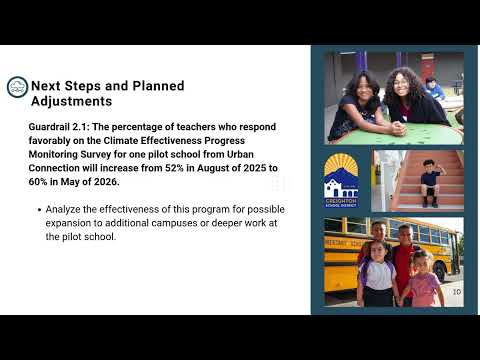
Guardrail 2, the presenter said, requires the superintendent to avoid conditions, practices or procedures that are inequitable or insufficient for students. Interim measure 2.1 tracks the percentage of certified staff responding favorably on a climate-effectiveness survey; the district set a goal of increasing the pilot school's favorable responses from 52% (August 2025) to 60% by May 2026 and reported a post-survey result of 63%.
Interim measure 2.3 measures instructional practice by the share of observed lessons scoring three or higher on the learning-walk rubric for engagement and rigor. "We not only met the goal, but exceeded the goal by reaching 44% in March of 2026," Dr. Kim said; the district began the year with 21% of lessons observed scoring a three or four.
District staff attributed growth in the survey's systems domain — which rose 12% overall — to a partnership with Urban Connection that focused on schoolwide operational structures and restorative practices. "The pilot school focused their work with Urban Connection on restorative practice, which saw a remarkable increase of 22%," Dr. Kim said, citing specific subdomain gains: behavior interventions (+13%) and positive reinforcement (+13%). Systemic expectations showed a 1-point decline.
All nine district schools showed improvement in learning-walk outcomes across the year, the presentation said. Staff identified instructional strategies that supported those gains, including Kagan structures, scaffolds to increase depth of knowledge, and questioning techniques that ask students to explain their thinking. The presenter said those practices, along with classroom walkthroughs, community circles and targeted professional development, supported the increases in observed rigor and engagement.
Board members asked several follow-up questions. When asked how the district uses effective teachers to mentor peers, Dr. Kim described coalitions of expert teachers and team leads, site-based professional development and partnered observation and coaching. On data transparency, a board member asked for school-level disaggregated results for interim measure 2.1; Dr. Kim said Urban Connection's work is currently limited to a single pilot site and that disaggregated school-by-school data would be available only if the work expands.
Board members also pressed on the building-relationships domain, which rose from 49% to 57% — the smallest gain among domains. Dr. Kim said Urban Connection uses a three-phase framework (unpacking foundational needs, implementation and support, and strengthening internal capacity) and pointed to subdomain improvements such as non-academic relationships and parent connection (each up 10%).
When asked whether improved teacher climate scores and learning-walk results correlate with student outcomes, Dr. Kim framed these metrics as leading indicators tied to adult behaviors: "They are important conditions for improved student outcomes," she said, adding that such changes support better attendance, behavior and engagement.
Board members noted volatility in learning-walk scores — a drop from 38% at the end of the previous year to 21% in the first quarter before recovery to 44% — and asked whether that should raise sustainability concerns. Dr. Kim attributed the early dip largely to the timing of observations and early-year emphasis on relationship-building, and cited new staff joining schools as a contributing factor. She said the district will work to align early-year indicators with learning-walk expectations so gains are more stable throughout the year.
A board member also asked about interim measure 2.2 (IEP participation), which appeared grayed out with no data in the report. Dr. Kim said this is a May-to-May goal and that schools are still collecting IEP participation data; she said Miss Kaiser, the director of exceptional student services, will present an update at the June board meeting.
On measurement reliability, Dr. Kim described a multi-year, phased approach to learning walks: beginning with large-group observations to build common language, moving to smaller observation teams, aligning to the Danielson model and requiring classroom evidence to support ratings. She said the district is developing a "look-for" guide to clarify indicators for observers and teachers.
The presentation closed after board-member questions and corresponding responses. The board is scheduled to receive a separate update on the IEP participation measure at a future meeting.