Get Full Government Meeting Transcripts, Videos, & Alerts Forever!
Get email alerts on the Police Accountability topic
No spam. Unsubscribe anytime.
Dr. Lee Anderson says Cleveland made substantial consent-decree progress but monitoring team flagged administrative downgrades
Summary
The police accountability team reported a net gain of compliance upgrades in 2025 while acknowledging several administrative downgrades and outlining community engagement, analytics, and upcoming assessments through 2026–27.
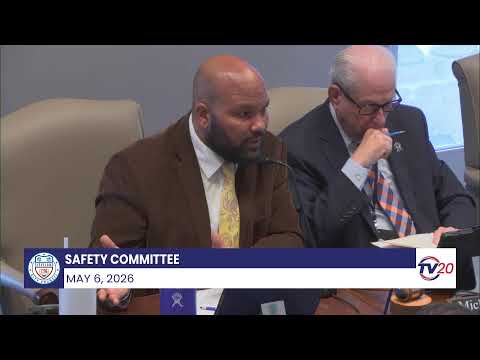
Dr. Lee Anderson, executive director of the police accountability team, told the Cleveland City Council Public Safety Committee on May 13 that the city saw substantial measurable progress toward compliance with the federal consent decree but that several administrative areas need more work.
"I am Dr. Lee Anderson, executive director of the police accountability team," Anderson said as she opened the presentation and introduced the unit’s work updating the council and the public. Hannah MS, a performance auditor with the team, summarized the monitoring reports: "In [the 18th semiannual report] we received 29 upgrades and three downgrades," and across seven 2025 assessments the city recorded 173 upgrades and seven downgrades, producing a net 166 upgrades, she said.
The presentation broke down recent assessments filed with the court. The crisis-intervention review (filed Sept. 26, 2025) concluded Cleveland had established a robust crisis-intervention program, with low arrest and use-of-force rates and increased hospital transports rather than arrests. The recruitment review (Dec. 11, 2025) found timely background investigations and that two-thirds of 2024 applicants were racial minorities and roughly 25% were women. A large use-of-force assessment (filed Feb. 4, 2026) reviewed hundreds of incidents and concluded about 97% of level-1 and level-2 uses were constitutional and that internal investigations and supervisory systems were functioning.
Pat staff described several ongoing initiatives meant to translate the monitoring data into community-facing change: a Sigma Squared independent analysis of 2024 stop-and-search data, which Anderson said "found no evidence of process bias after controlling for key factors such as stop context, location, and reason," a new Benchmark Analytics early-warning dashboard for officer performance, expanded youth and community outreach (including events with Jack and Jill and the Junior Mayor’s Association), and a Kent State–led community-engaged survey and listening campaign to measure public trust.
Council members pressed the team on remaining downgrades and operational gaps. Hannah MS said the downgrades in the 18th semiannual mostly concerned the inspector-general office (policies and procedures) and the officer-intervention program (OIP) where monitoring found insufficient documentary evidence while systems such as Benchmark Analytics are still being implemented. On use-of-force downgrades she told the committee these were primarily "administrative" or equipment/audit issues (for example, changes to electrical-control-weapon downloading procedures), not findings that officers’ on-scene conduct was unconstitutional.
Council members also raised staffing and street-level visibility concerns. One member said reduced patrol presence has limited community contacts and traffic enforcement; staff responded that CPOP coordinators and NRG (neighborhood resource group) officers have been deployed and that recruit-class sizes have increased but acknowledged recruitment and deployment remain challenging.
Anderson said the police accountability team is preparing for the monitoring team’s discipline assessment (May–Oct. 2026), reviewing 2025 discipline cases from OPS and internal affairs and building internal audit and tracking to respond quickly to any monitor findings. She said PAT will continue to meet with the monitoring team and DOJ, advocate for recognition of compliance progress where warranted, and work with command staff to document practices for the monitor’s review.
The presentation prompted a series of follow-up commitments from staff: to provide council with the cost and contract details for Benchmark Analytics, to share the Sigma Squared and monitoring-team stop-location reports, and to circulate the Kent State survey plan and IRB status. The committee set a special appearance of the federal monitor for May 13 at 10 a.m. (corrected date announced in the meeting).
What’s next: the police accountability team said it will continue working with the monitoring team to prepare for 2026 assessments, implement Benchmark and records-process improvements, and begin community listening and survey work this summer.