Get Full Government Meeting Transcripts, Videos, & Alerts Forever!
Get email alerts on the Community Engagement topic
No spam. Unsubscribe anytime.
Paula Baxter outlines strategic engagement plan, cites tenant surveys, focus groups and developer funding
Summary
At the May 1 meeting, Paula Baxter presented a targeted engagement strategy for implementing the Healthy Buildings ordinance that prioritizes tenant input, coordinated technical outreach, surveys and focus groups, and seeks developer contributions to support EPB implementation.
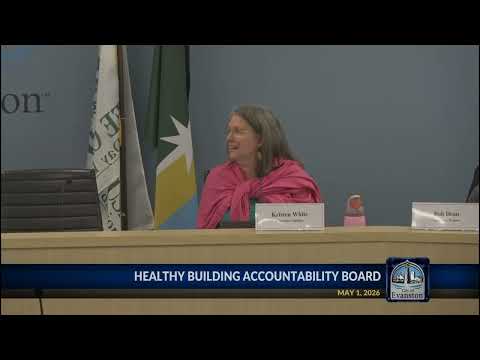
At the Healthy Buildings Accountability Board meeting May 1 in Evanston, Paula Baxter presented a detailed community engagement strategy to guide rulemaking for equity‑prioritized buildings.
Baxter said engagement should be strategic and not a full partnership with every constituency; instead, the board should inform and consult affected groups so they can “think critically” about how proposed rules would affect them. She urged the board to reach tenants, building owners, environmental and sustainability groups, downtown business organizations and developers, and to develop trusted champions who can vouch for the effort publicly.
Baxter warned of tricky stakeholder dynamics: she noted Northwestern University will be an important and potentially difficult partner and said she may need to recuse herself from Northwestern outreach. She also emphasized technical learning—focus groups led by neutral experts, site visits and community surveys—so the board can draft feasible rules for buildings that vary widely in age and heating systems.
Baxter raised funding as a component of outreach and implementation, citing a developer donation as an illustrative example: “605 Davis just gave us $125,000,” she said, noting such contributions could be used to fund EPB supports, workforce development and other community benefits. She urged the board to cultivate inter‑board briefings and community benefit agreements so development can help underwrite implementation.
Staff updated the board on a technical assistance grant with the American Council for an Energy‑Efficient Economy (ACEEE) and a renter survey timeline. Staff said ACEEE is drafting a renter survey to be translated and preliminarily tested, with a likely launch at the end of June and fieldwork in July, followed by analysis in August–September; a landlord survey or focus groups are planned for late 2026 or early 2027 depending on renter survey findings.
Baxter’s presentation and the staff grant update framed the board’s immediate outreach work: draft survey instruments, coordinate with the technical committee, prioritize tenant outreach, and identify potential developer funding and trusted messengers to support eventual rule adoption.
The board asked Baxter and volunteers to return with a fleshed‑out stakeholder list, a draft outreach plan and recommended next steps for drafting rules.