Get Full Government Meeting Transcripts, Videos, & Alerts Forever!
Get email alerts on the Labor And Staffing topic
No spam. Unsubscribe anytime.
Teachers, parents and union press Ann Arbor school board after tentative contract is overwhelmingly rejected
Summary
Dozens of teachers, parents, students and union leaders urged the Ann Arbor Board of Education to prioritize teacher pay and staffing after Ann Arbor Education Association members overwhelmingly rejected the district’s tentative agreement. Commentators also raised concerns about health‑insurance cost sharing, class sizes and budget priorities.
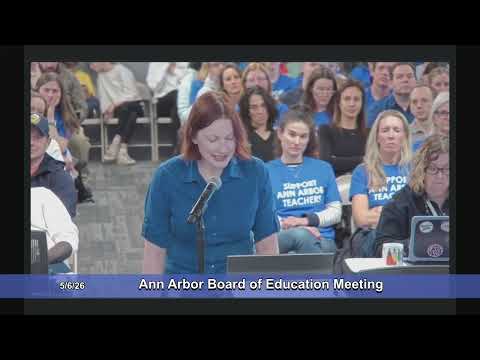
Dozens of teachers, parents and students told the Ann Arbor Board of Education on May 6 that the district must make better offers in ongoing contract talks, pressing trustees to prioritize pay and staffing to stop an exodus of educators.
The public‑comment period, which lasted more than an hour, centered on the district’s tentative agreement with employees that members of the Ann Arbor Education Association (AEA) rejected. “This proposal does not meet the needs of our students or our staff,” Fred Klein, president of the AEA, said, reporting that 1,084 members voted “no” in the ratification election while four voted “yes.”
Why it matters: Teachers and support staff are the district’s main instructional resource, speakers said, and many described practical consequences of the bargaining impasse — canceled events, work slowdowns and extra unpaid labor across classrooms — that they said are harming students’ learning experiences.
Several classroom teachers and parents detailed how the district’s offer would shift more health‑insurance costs onto employees and reduce planning time and elementary specials (art, music, PE and library), which they said would lower instructional quality. AEA leaders and paraeducator representatives urged the board to ensure bargaining recognizes rising premiums and the local cost of living.
“Budgets are moral decisions,” parent Wendy Welch said. “We must be transparent about where money is going, and our community asks that you prioritize teacher and student well‑being.”
Teachers described compounding pressures: higher health premiums, stagnant pay schedules and increased class sizes. Spanish teacher Peg Lederer, a 28‑year educator, told trustees she voted “no” on the tentative agreement despite approaching retirement, citing what she called inadequate raises and pension changes that she said undercut long‑time staff.
Union perspective: Klein framed the union’s position as a call for a “real reset” and said members are ready to return to bargaining. He said the proposal undercut both compensation and classroom conditions and included contract language he described as allowing the district to ignore future laws aimed at improving health‑care affordability.
Board response and next steps: Superintendent Jaz Parks provided clarifications after public comment, noting district priorities on student safety, and reaffirming that central‑office increases occur only when teacher increases are authorized and at a commensurate rate. Trustees announced a May 13 budget work session and asked the public to submit questions in advance.
What comes next: AEA leaders said the union is prepared to resume bargaining. Trustees signaled an intent to consider budget and facility changes — including potential building or land sales and program realignments — to improve long‑term fiscal capacity for staff compensation. The district has not announced a schedule for returning to formal bargaining following tonight’s public comments.
Sources: Public testimony to the Ann Arbor Board of Education (May 6); statement by Fred Klein, president, Ann Arbor Education Association.