Get Full Government Meeting Transcripts, Videos, & Alerts Forever!
Get email alerts on the Assisted Living Legislation topic
No spam. Unsubscribe anytime.
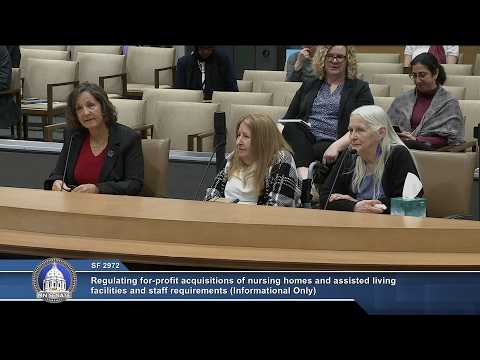
Senator Double and colleagues hear residents’ accounts as committee considers bills to curb assisted‑living fee hikes
Summary
A Minnesota Senate committee heard residents and advocates describe sudden rent and fee increases, alleged staffing cuts and for‑profit owner practices in assisted‑living facilities and discussed bills that would require operators to justify fee hikes and limit related party self‑dealing.
Senator DOUBLE opened a committee hearing to review several bills (sponsors referenced Senate file numbers aloud) after members said reports of sharp rent and fee increases and declining care warranted additional testimony.
Pat Hunt, president of a resident council in Bloomington, told the committee her building was sold to an investment company that immediately imposed new fees and raised rent, including a $350 increase on a two‑person unit and a 5% rent hike that she said outpaced residents’ Social Security cost‑of‑living adjustments. "We saw immediate increases in fees...we don't see any services," Hunt said, describing reduced care quality and residents moving out.
Vicky Wagner, who said she has lived in senior housing in Bloomington for nearly five years, described new monthly companion fees ($65) and repeated late charges tied to Social Security timing; she said package‑handling fees of $7 and cumulative annual rent increases (she estimated a roughly 35% rise over several years) have made retirement unaffordable for some residents. "That's 1,500 more a year that I have to pay and I just don't think that's right," Wagner said.
Family member Don Talbert testified his parents’ facility raised charges so that their invoice grew by almost $2,000 per month after a management change; he said 15–20 residents have given notice to vacate and that management refused requests to grandfather current residents or phase in increases. "They knew the pricing and still chose the nuclear option to raise prices 20 to 40%," Talbert said, urging the committee to pass protections.
Representatives from the Office of Ombudsman for Long‑Term Care and Elder Voice Advocates summarized statewide patterns: investment‑driven ownership changes followed by staffing cuts, reports of reduced direct care spending, and a disproportionate share of substantiated maltreatment and wrongful‑death findings in for‑profit settings. Chris Sumburgh of Elder Voice Advocates cited investigations and said the data show concentrated harm in certain provider models.
Senators questioned regulatory authority and enforcement. Committee members asked whether the Department of Health should be empowered to approve fee increases beyond consumer price indexes; witnesses noted that assisted‑living licensure and many related protections are within the Department of Health's existing oversight, and sponsors said legislation would clarify cost oversight and require providers to justify new fees or service reductions.
Lawmakers revisited prior negotiations and amendments, saying an amendment earlier this session removed a prohibition on self‑dealing and that past compromises weakened protections; sponsors pledged to pursue transparent, public policy changes this year to limit related‑party transactions and require that a significant share of operator revenue go to direct resident care.
The committee did not take a formal vote during the hearing. Sponsors thanked residents and advocates for testifying and said they will continue to refine legislative language and pursue enforcement mechanisms.
Next steps: the bills remain under committee consideration and sponsors indicated they will work to keep self‑dealing prohibitions and fee‑justification language in final policy packages.