Get Full Government Meeting Transcripts, Videos, & Alerts Forever!
Get email alerts on the Urban Growth Strategies topic
No spam. Unsubscribe anytime.
EAC hears Urban Growth Strategies overview; staff says Eugene must plan for about 26,000 new housing units
Summary
City staff told the EAC that under the state's Oregon Housing Needs Analysis Eugene must plan for roughly 26,000 new dwelling units over 20 years and outlined the Urban Growth Strategies project phases, adoption packages and how the contextualized housing need will inform land use and policy changes.
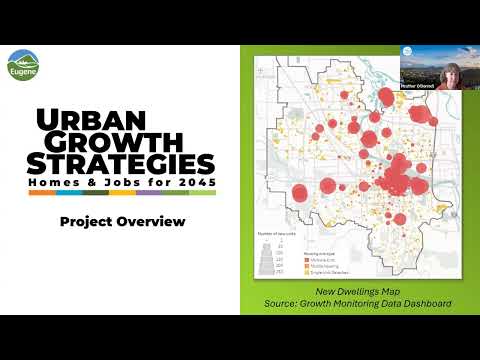
City of Eugene planning staff gave the Technical Advisory Committee (EAC) an overview of the Urban Growth Strategies (UGS) project and the state's Oregon Housing Needs Analysis (ONA), saying the new ONA allocation requires the city to plan for roughly 26,000 new dwelling units over the next 20 years.
Leah Roush, a senior planner on the long-range planning team, said the UGS umbrella includes a parcel-specific land use map modernization, a buildable lands inventory, an eight-year housing production strategy and multiple code amendment packages. She told the EAC the work is largely state-mandated but provides an opportunity to advance local priorities such as housing affordability and climate-friendly area designations.
Roush said the ONA methodology now factors household formation, second/vacation home losses and unmet need from decades of underproduction, and that the state's January allocation gives Eugene a 20-year need of about 26,000 units. She put that in local context: Eugene currently has roughly 92,000 dwelling units in the urban growth boundary, so the allocation represents an increase of nearly 30% in housing stock over 20 years.
Staff outlined the phased approach the city will use: a near-term adoption package this year with statemandated zoning and code amendments (including middle housing clarifications, single-room-occupancy and micro-village uses, and procedural changes to expedite certain residential land use applications); a second package of broader policy and code changes (including climate-friendly area designations and residential zone updates); and a later, 2027 package focused on the land-supply accounting and buildable lands inventory that pulls technical studies together for the final 20-year math.
Roush said the CHN (contextualized housing need) is the local analysis required to translate the ONA allocation into the specific housing types, characteristics and locations the city should plan for. She said the CHN will be used to determine where efficiency measures or code changes can meet need and, if necessary, where UGB expansion would be required to accommodate remaining demand.
Staff also explained available legal compliance paths. Roush previewed optional state "safe harbor" approaches for certain planning choices and noted one state minimum requirement currently in the rules for home-ownership planning. As an example of safe-harbor metrics, staff said a safe-harbor path would require planning for at least 20% middle housing and at least 40% multi-unit housing as part of the housing-type mix.
Committee members pressed staff on integration with jobs and transit planning and on how affordability bins from the ONA will translate to local coding and investments. Staff said the GIS location analysis under development will explicitly consider proximity to jobs, transit, civic destinations and environmental hazards and that further mapping and draft results will be shared at a future meeting.
The meeting closed with staff noting next steps: a deeper location-oriented presentation in the next meeting, return-to-EAC discussions about safe-harbors, and ongoing work toward adoption packages. No formal action or vote was taken by the committee during this session.