Get Full Government Meeting Transcripts, Videos, & Alerts Forever!
Get email alerts on the Bicycle Master Plan topic
No spam. Unsubscribe anytime.
Agoura Hills planning commission recommends council certify Bicycle Master Plan EIR and adopt 30‑mile bikeway program
Summary
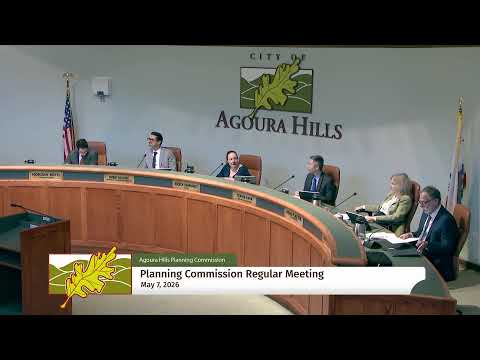
The Agoura Hills Planning Commission voted 4–0 on May 7, 2026, to recommend City Council certify a programmatic environmental impact report and adopt the Agoura Hills Bicycle Master Plan, a VMT mitigation exchange/banking program, and a general plan amendment (Case PZ-20226-61-GPA). Commissioners raised safety and cultural‑resource concerns and asked about enforcement, interjurisdictional coordination and project‑level environmental review.
The Agoura Hills Planning Commission voted 4–0 on May 7, 2026, to recommend that the City Council certify the final programmatic environmental impact report (EIR) for the Agoura Hills Bicycle Master Plan, adopt the master plan and its mitigation‑banking program for vehicle‑miles‑traveled (VMT), and approve a general plan amendment (Case PZ‑20226‑61‑GPA). Commissioner Stein made the motion and Commissioner Roth seconded; the roll call vote recorded four "yes" votes.
The recommendation would advance a citywide bicycle plan that staff said proposes about 30.1 miles of new bikeways and improvements to expand the existing network. Staff described two priority projects analyzed in detail in the programmatic EIR: the Media Creek Pathway, a roughly two‑mile Class I off‑road path, and a roughly 0.2‑mile connection behind Agoura High School. Charmaine Yan Bau, the city’s director of public works and city engineer, told the commission the plan aims to increase safety, reduce single‑occupant vehicle travel and align the city with regional climate and active‑transportation goals. "I'm Charmaine Yan Bau, director of public works, city engineer, and tonight I'm pleased to bring forward ... the Agoura Hills Bicycle Master Plan programmatic EIR," she said.
Why it matters: the programmatic EIR would provide a CEQA framework for many future bicycle projects and create a VMT mitigation exchange and banking program that could fund implementation. In a programmatic analysis, the EIR evaluates broad system‑level impacts; staff and the consultant repeatedly emphasized that individual projects still require future site‑specific environmental review when they move into design and construction. Taylor Freeman, senior environmental planner for Rencon Consultants, summarized the CEQA findings and said that "impacts related to cultural resources would be considered significant and unavoidable" at the programmatic level, which requires the city to adopt findings and a statement of overriding considerations if the council proceeds.
What the EIR and plan include: staff said the existing city network includes about 1.3 miles of Class III (shared) routes and roughly 9.2 miles of Class II lanes, and the proposed BMP would expand the network to cover more of the city. The EIR analyzed typical CEQA issue areas, three alternatives (no project; project without the two priority facilities; and an on‑street only option limited to Class II/III facilities), and mitigation measures; staff said most impacts can be mitigated to less‑than‑significant levels, but cultural‑resource impacts tied to ground disturbance were identified as potentially significant and unavoidable at this programmatic stage.
Public and agency input: staff reported that the notice of preparation was published Jan. 13, 2025, with scoping and a subsequent draft EIR circulated Nov. 25, 2025–Jan. 31, 2026. During the draft review the city received two agency comment letters (from Caltrans and the California Department of Fish and Wildlife) and no comment letters from members of the public; staff said written responses to those agencies are included in the final EIR and that no changes to the draft EIR were made in response to those comments.
Commissioner questions and concerns: commissioners asked how subsequent project‑level review would be handled (Charmaine said follow‑on projects would return to staff, the planning commission and city council as required), and whether the city had coordinated with neighboring jurisdictions on corridor connections (staff said early contact has occurred and further coordination would take place during project design). Commissioner Platzer pressed staff on safety, lighting and e‑bike issues, noting concerns about collisions and door‑zone conflicts; Charmaine said the BMP does not regulate e‑bikes but the city recently adopted an ordinance prohibiting e‑bikes on sidewalks and in parks, so e‑bikes would be routed to roadway bicycle facilities and are subject to the rules of the road. Staff described design choices (wider Class II lanes or Class IV protected lanes) to reduce door‑zone risks.
Vote and next steps: after deliberations in which commissioners said they could make the CEQA findings, Commissioner Stein moved to adopt the staff recommendation and Commissioner Roth seconded. The planning commission approved the recommendation 4–0; the matter now goes to the City Council, which must decide whether to certify the programmatic EIR, adopt the Bicycle Master Plan and approve the related general plan amendment. Staff emphasized that some future projects may qualify for statutory or categorical CEQA exemptions while others will require additional environmental review before construction.
Context and timing: staff said the final BMP was released for public review in August 2025 and there is no single projected completion date for full implementation; projects will proceed as funding (including grants) and project‑level environmental review allow. Commissioner Roth closed with a reminder about a community open house at Fire Station 89 this weekend; the commission adjourned and scheduled its next regular meeting for May 21, 2026.