Get Full Government Meeting Transcripts, Videos, & Alerts Forever!
Get email alerts on the School Budget topic
No spam. Unsubscribe anytime.
Marcellus board outlines $43.33 million 2026–27 budget with 2.7% levy increase; vote set for May 19
Summary
Superintendent Jean Charlo and School Business Executive Don Weber presented a $43,330,431 proposed budget that relies on a $1.5 million appropriated fund balance and a 2.7% tax-levy increase. The hearing explained potential contingency cuts if voters reject the budget and described two additional ballot propositions for buses and a library levy.
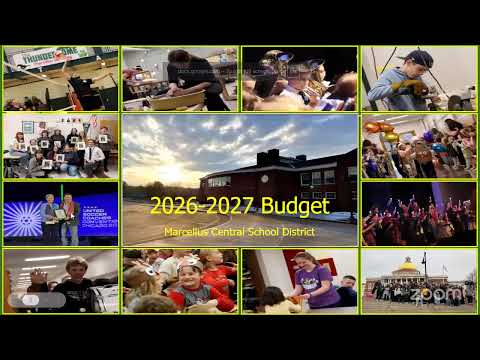
Superintendent Jean Charlo and School Business Executive Don Weber presented the Marcellus Central School District’s proposed $43,330,431 budget for 2026–27 at the annual public hearing on May 11, 2026. Charlo described the budget as aligned to student programming while noting the district plans to rely on an appropriated fund balance of about $1.5 million to cover unforeseen costs.
Charlo told the audience the proposed tax-levy increase for the coming year is 2.7 percent. "The tax levy increase this year is 2.7%," she said, explaining the change reflects the state’s multi-step cap formula and that the district needs a simple majority to pass the levy. Don Weber said the district faces a roughly $1.5 million initial budget gap driven by contractual salary increases and rising utility and insurance costs; staff reductions and other adjustments reduced an initial $2.5 million maintenance cost estimate to a smaller net increase.
Why it matters: With statewide enrollment declines constraining foundation aid, the board said the district must balance program preservation against fiscal realities. Weber explained that state aid accounts for roughly 39 percent of district revenue while the tax levy provides about 54 percent, limiting the district’s room to expand spending beyond the modest new revenue expected.
Key propositions and contingency plan: Administrators outlined three propositions to appear on the May 19 ballot — the 2026–27 budget, authorization to purchase transportation vehicles on a 10-year replacement schedule, and the legally required library levy. The transportation proposition would authorize up to $867,000 for vehicle purchases (three 35-passenger buses, one 36-passenger bus, one wheelchair-accessible bus, and a 10-passenger van); the district said it is purchasing gasoline-powered buses, not electric, at this time.
Weber also described the contingency budget that would take effect if voters reject the budget: removal of nonessential equipment (about $87,500) and elimination of non-contractual salary increases (about $221,000) for an initial reduction close to $300,000. He noted the board could choose additional reductions if it elected not to use fund balance to cover the gap created by a failed budget.
Local tax impacts: Weber detailed how different town assessment practices and state equalization rates across the district’s six towns can cause varying tax-bill effects for individual homeowners even when the overall levy increases by a uniform percentage. He cautioned that illustrative slides can appear to show tax decreases in some cases because of assessment and equalization changes rather than lower levies.
Next steps: The budget vote is scheduled for Tuesday, May 19. Administrators encouraged voters to review the mailed budget newsletter and district website materials and to contact the district office with questions.
No formal budget approval occurred at the hearing; the hearing was adjourned and the board proceeded to its regular business meeting.