Get Full Government Meeting Transcripts, Videos, & Alerts Forever!
Get email alerts on the Signs topic
No spam. Unsubscribe anytime.
Parker planning commission recommends keeping current sign code after debate over electronic signage
Summary
After weeks of review at the council’s request, the Planning and Zoning Commission on May 14 debated electronic and illuminated signs, cited existing code provisions that prohibit flashing or glare‑creating signs, and voted to recommend no immediate changes to chapter 153.
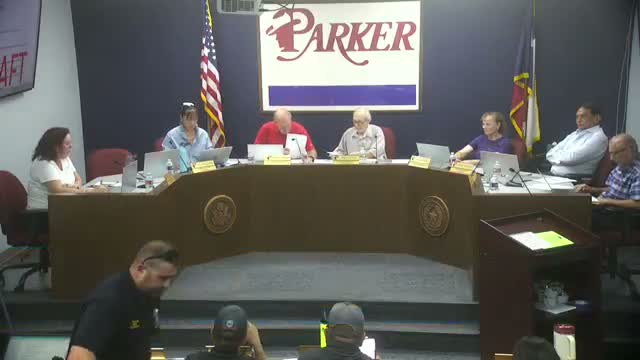
Parker — The Planning and Zoning Commission on May 14 considered a city council referral to review chapter 153 (signs), prompted by a church’s interest in an electronic sign. After extended discussion about dynamic content, glare and driver distraction, the commission voted to recommend that city council make no immediate changes to the sign ordinance.
Commissioners and staff contrasted landscape‑lit monument signs with electronic or backlit signs that change or flash. Staff (speaker 8) read code language that the commission relied on in the discussion: “Signs which are illuminated with lights which cause glare to enter or upon the surrounding area or any property used for residential purposes or which distract operators of vehicles …” and that prohibited signs include those that “flash, move, rotate, scintillate, blink, flicker, vary in intensity or color, or use intermittent electrical pulsation.”
Members debated whether to allow static backlit signs but continue to bar dynamic electronic content that changes frequently or uses flashing/animation. Several commissioners said the current code’s nuisance and glare provisions already address the public‑safety concerns; others warned that changing the ordinance for a single requester could open broader commercial demands.
The commission noted the Zoning Board of Adjustment (ZBA) remains the process by which a party may pursue a variance for a sign. Staff confirmed the variance fee handles notification requirements (including required mailings to neighbors) and identified the current fee as $600; members raised concerns that the cost and the variance process could be a barrier for nonprofit or small applicants.
Commissioners also observed that Parker currently has minimal commercial zoning (one planned development at Lucas and Lewis), so broad changes to the sign code would likely precede any wider commercial expansion. The commission’s motion — moved by a member and seconded by the chair — recommended that the city council not modernize the sign ordinance at this time and instead revisit it only if the city deliberately pursues broader commercial activity.
The commission approved the motion and will forward the recommendation to city council. No immediate code amendments were adopted at the meeting.