Get Full Government Meeting Transcripts, Videos, & Alerts Forever!
Get email alerts on the Oak Wilt topic
No spam. Unsubscribe anytime.
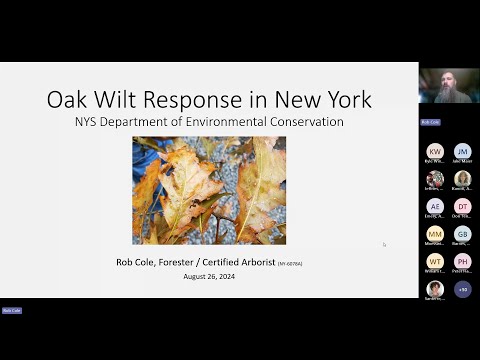
Rob Cole details New York’s oak wilt detection, quarantine and containment practices
Summary
Rob Cole of the New York State Department of Environmental Conservation described New York’s oak wilt detection, sampling and containment approach, including quarantine zones, trenching to sever root grafts, and when the state will remove infected trees. He answered questions about funding and legal authority during a Land Use Planning Commission briefing.
Rob Cole, a forester and certified arborist with the New York State Department of Environmental Conservation, outlined New York’s approach to detecting and containing oak wilt, a fungal disease that kills oak trees via both insect vectors and root graft transmission. He described early detections, sampling procedures, quarantine rules and on‑the‑ground techniques used to limit spread.
Cole said oak wilt was first found in New York in 2008 near Albany and that the pathogen has since shown up in multiple, geographically distinct locations including sites south of Rochester near Canandaigua Lake and suburban neighborhoods on Long Island. “Oak Wilt was first discovered in New York in 2008,” he said, adding that the original site produced another detection about five years later, underscoring persistence in local landscapes.
Cole explained two primary transmission routes: overland spread by sap beetles that visit sporulating patches on dead trees and underground spread through root grafts between adjacent oaks. He said sporulating “pressure pads” form under bark after trees die and that beetles can carry spores to fresh wounds in spring, producing the characteristic midsummer leaf‑drop and orange‑brown discoloration. Root graft transmission can move the fungus from one tree to another within a single growing season, so management must address both vectors.
To limit underground spread, DEC uses the broom‑table model to estimate how far a fungus could travel through root grafts in a season and then applies targeted responses. In early Glenville work DEC removed trees within about 150 feet of infected stems — roughly 90 trees at that site — but later relied on the model to avoid unnecessary removals. For individual properties, DEC may employ trenching (digging to about five feet) to sever root connections and install a permeable fabric liner so roots will not re‑graft across the break, allowing some high‑value nearby trees to be saved when feasible.
On detection and sampling, Cole described field protocols: branch sampling of symptomatic limbs (roughly 1‑inch diameter, 8–10 inches long; multiple samples per tree) with samples kept cool and shipped overnight to a diagnostic lab to avoid false negatives. He noted a leaf‑sampling protocol was expected to simplify collection in the near term.
Policy tools include graduated quarantine zones. Cole described a practical approach that scales from site‑level restrictions to half‑mile, townwide and countywide quarantines depending on the number and proximity of detections. In urban cases such as a Brooklyn cemetery DEC restricted movement of oak wood and required winter‑only removal under permit; DEC also enforces a New York firewood movement regulation that limits movement beyond roughly 50 miles to reduce long‑distance human transport of infected wood.
Cole described outreach and surveillance tactics used to detect and limit spread: door‑to‑door ground surveys in suburban neighborhoods, multilingual public materials (Spanish and Mandarin), bus‑shelter ads, social media reporting channels, aerial surveys and targeted drone reconnaissance around beetle trap catches. He noted that spor mats can be cryptic and recommended that the public focus on timing and leaf symptoms rather than relying solely on a single idealized image.
Cole discussed experimental tools and research: trap networks and collaborations (including work with Cornell) to determine beetle distributions, limited detector‑dog trials that showed promise in controlled tests, and a drone program to locate suspect trees from trap sites. He emphasized beetle activity typically peaks May–early July but that positive trap catches can occur later in the season, complicating source tracing.
On costs and responsibility, Cole said DEC often conducts and pays for management on private property so removal and mitigation happen quickly and according to best practice. He told attendees that DEC’s 11‑year oak wilt program has spent under $1 million in total (personnel are the largest cost item), with site costs highly variable: work in suburban lots or crane‑assisted removals can approach several thousand dollars per tree.
During Q&A, a participant who identified themself as a program manager asked whether federal agencies fund DEC’s oak wilt work. Cole said the animal‑plant health regulator (APHIS) does not fund oak wilt because it is not a federally regulated pest; instead DEC has received U.S. Forest Service funds and draws on New York’s Environmental Protection Fund for invasive‑species projects. He also said New York state law grants DEC access to private properties for forest‑health interventions and that participation in management is required, although DEC seeks cooperative solutions and rarely resorts to enforcement.
Cole recommended caution when planting red oaks in areas with recent oak wilt detections and said quarantine areas may include a five‑year restriction on planting red oaks. He closed by urging municipalities and landowners to monitor for midsummer leaf‑drop and to report suspect trees to diagnostic services so control measures can be timely.
The briefing transitioned to a broader Forest Service conditions update; organizers encouraged attendees to subscribe to posted conditions reports and said another update is planned in December.