Get Full Government Meeting Transcripts, Videos, & Alerts Forever!
Get email alerts on the Budget Long Term Plan topic
No spam. Unsubscribe anytime.
Commerce City staff warns of potential budget gap by 2031, proposes TABOR mill-levy retention and residential trash fee
Summary
City finance staff and consultants presented a 10-year financial model that projects annual deficits beginning in 2031 under a no-change base case and recommended a three-part approach — a ballot measure to retain TABOR-constrained property-tax growth, a residential trash-service fee and a future mill-levy adjustment — paired with community engagement.
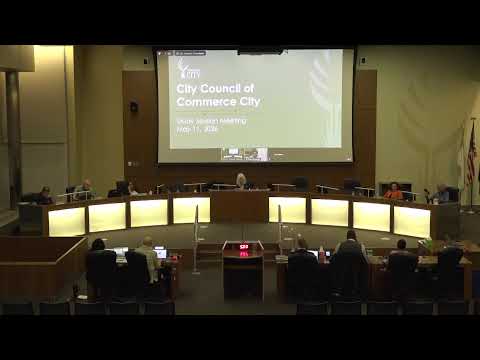
City finance staff and outside consultants told the Commerce City Council during a study session that the city’s current revenue and expenditure trajectory would produce annual general-fund deficits by about 2031 under a base-case projection that assumes no major policy changes.
"We end up with a deficit starting in 2031," Claire Pritchard, a consultant on the long-term-financial-plan team, said as she reviewed the model. The presentation showed average forecast assumptions of roughly 4.6% annual revenue growth (driven largely by sales and use tax) and 6.8% annual expenditure growth (driven by staffing, salary and benefits, and rising contract and IT allocations). Under the base case, consultants projected unassigned fund balance pressures and the possibility of depletion several years after the first deficits appear.
Staff proposed a three-step strategy to address the structural gap: place a ballot measure this November asking voters to retain the city’s TABOR-related property-tax allowance (staff estimated retention at roughly $1.4 million annually and described the homeowner impact as about $67 per $100,000 of assessed value); identify and implement a reasonable monthly residential trash-service fee (staff provided preliminary options in the $10–$20 per month range and a very high-level estimate of roughly $3 million in net revenue depending on design and collection costs); and, if needed, consider a future mill-levy increase to re-balance the city’s heavy reliance on sales and use tax (Commerce City was shown as more dependent on sales/use tax than several peer jurisdictions).
Council members pressed staff on distributional impacts and timing. Several members asked for more analysis of alternatives to revenue increases, including possible expenditure reductions, phased approaches to fees, and targeted relief for residents who might be disproportionally affected. Members also asked for more and broader public engagement than the two July events planned by staff; staff agreed to expand outreach and to provide Spanish-language materials and additional forums. City staff emphasized that the step to place the TABOR-retention question on the ballot requires explicit council direction and a short runway for this year’s election calendar.
Staff and consultants also noted that the city’s 2026 first‑quarter report includes a one-time audit payment that inflated certain revenue categories this quarter and advised caution when reading short-term trends.
Next procedural steps: staff will pursue expanded public engagement in July, return with detailed cost and design options for a trash-service fee in a July study session, and provide additional modeling and sensitivity analysis to the council before final decisions about any ballot measures or tax changes.