Get Full Government Meeting Transcripts, Videos, & Alerts Forever!
Get email alerts on the Opioid Response topic
No spam. Unsubscribe anytime.
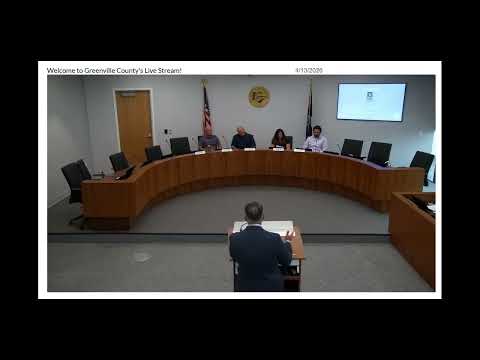
Greenville County committee approves SCORF application to sustain jail and community opioid programs
Summary
The Greenville County Committee on Finance voted 3–1 to approve applying for $3.673 million from the South Carolina Opioid Recovery Fund to continue jail-based medication‑assisted treatment and community services; presenters reported measurable declines in county opioid deaths and outlined program costs and sustainability concerns.
Greenville County’s finance committee voted 3–1 to approve the county’s application for fiscal‑year 2027 funds from the South Carolina Opioid Recovery Fund (SCORF), supporting medication‑assisted treatment at the county detention center and partner community programs.
Lindsay Sloan, director of special projects and grants for Greenville County, told the committee that "as of the last report in March 2026, Greenville County has a little over $5.1 million available" in SCORF money and that the county is requesting $3.673 million this year so it retains roughly $1.4 million in carryover for sustainability. She said SCORF money is limited to uses tied directly to opioid use disorder such as treatment, prevention, training and education and "cannot be used to supplant or replace any existing funds."
Dr. Israel Hollister, who described the county jail as the state’s busiest detention center, credited the county’s Medicaid‑assisted treatment (MAT) work with reducing fatalities. He reported that opioid‑related deaths in Greenville County fell from 215 in 2023 to 130 in 2025 and said 86 of the 130 decedents had a prior incarceration at the detention center. "None of those fatal overdose participants had ever been through our program at the jail," he said, arguing that the in‑jail treatment program appears to be mitigating deaths among participants.
Heather Harvell, the detention center’s medication‑assisted program manager and a nurse practitioner, outlined clinical operations: medically managed withdrawal including multi‑day suboxone tapers, initiation and continuation of MAT during incarceration, and monthly subcutaneous injections (referred to in the presentation as "bricks") to reduce diversion risk. She said the jail has screened more than 14,000 individuals since July 2025, initiated 477 suboxone tapers for withdrawal management and started 118 individuals on MAT while incarcerated (51 were continuations from community care). Harvell described discharge planning and warm handoffs to community partners to preserve continuity of care after release.
Becky Maddox, CEO of the Phoenix Center, described community partner results funded in part by SCORF support: 683 adults completed detox services, 422 adults connected to MAT in the community, nearly 1,400 people were tested for communicable disease (125 positives were referred for treatment), almost 4,000 people received therapeutic counseling and more than 1,700 connected with peer‑support services. Maddox said the number of people requesting services who could not be immediately served has fallen from about 100 per week to roughly 40 because of the expanded services.
Presenters outlined the program budget and staffing needs. County staff listed anticipated medication costs of "over $600,000" and said the monthly injectable doses referenced in the presentation cost roughly $1,500 each; the operational team at the detention center was described as about eight staff who provide services 24/7. Sloan said the county anticipates an additional ~$1.3 million in SCORF receipts by next year but emphasized the need to plan for sustainability as settlements and early large awards taper.
Councilors pressed presenters on repeat program participation and transparency. County and provider staff said repeat detention‑center participants were relatively low (estimated under 10–15%), while Phoenix Center estimated a higher repeat rate across its programs (about 40% of people served in a year had been seen previously). Councilor Collins asked how the SCORF application scoring and public reporting worked; staff said guaranteed political‑subdivision applications open quarterly, that a discretionary funding pot exists, and that quarterly and yearly reports are submitted through the SCORF portal. Staff committed to sharing submitted reports and dashboards with councilors.
The committee approved the county’s SCORF application by motion; the mover and seconder were not recorded in the transcript. The Chair announced the motion passed 3–1.
Next steps: staff will file the county’s SCORF application and follow up with the reporting materials and program dashboards requested by councilors. The committee immediately proceeded to community project items and adjourned after completing votes.