Get Full Government Meeting Transcripts, Videos, & Alerts Forever!
Get email alerts on the Budget topic
No spam. Unsubscribe anytime.
San Luis council reviews FY2027 budget as staff weigh a $1.5 million shortfall and salary options
Summary
City staff presented four salary options and outlined a $1.5 million funding gap driven by higher benefits costs and uncertain lease and construction revenues; the council directed staff to refine cuts and return a final proposed budget in June.
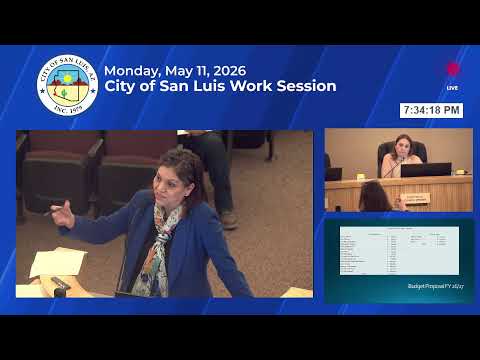
City staff presented the proposed fiscal year 2027 budget and four salary-adjustment options at a San Luis City Council work session, warning that one-time revenue gains mask a projected multi‑year decline and that benefits cost increases have widened the near‑term funding gap.
Roland Cenzas, the city’s finance director, told the council that an unexpected $700,000 in vehicle license and state income tax receipts improved this year’s position but that the city faces volatility in sales tax and potential state actions that could reduce state‑shared revenue by an estimated $200,000–$511,000. "We had an additional $700,000 that came in," Cenzas said, while cautioning that recent construction‑driven receipts will decline as major projects near completion.
HR staff presented four compensation scenarios: a targeted market adjustment for certain public‑safety civilian roles and step increases for others; a 3% cost‑of‑living adjustment (COLA) plus a years‑of‑service supplement (estimated cost about $1.6 million); moving many employees to midpoint pay levels (estimated about $5.3 million); or no increase (zero fiscal impact). Adela, the HR director, summarized the options and the retention rationale behind them and said the benefits trust approved a 15% increase in contributions to address a large stop‑loss exposure: "The trust approved a 15% increase in contributions," she said, noting the city’s share would rise by roughly $540,000 and employees’ share by about $100,733 under the cost split used.
Staff said the combined effect of the preferred salary option and higher benefits would create roughly a $1.5 million shortfall after applying some reserves and contingency assumptions, including $600,000 of lease revenue from a tenant (identified in the briefing as ACT) that is not yet confirmed. To cover the gap, administration proposed using limited reserves, deferring or removing select capital projects and instituting a hiring freeze for non‑essential positions. Cenzas described earlier reductions of about $8 million in capital projects and defended zero‑based review of operations as a means of finding additional savings.
Council members asked staff to return with more granular options for contract and program cuts, to identify which projects are grant‑funded and therefore not easily reduced, and to provide clearer staff‑by‑staff or classification‑by‑classification impacts of each salary choice. Staff said a final proposed budget will be presented in June and sought direction at this work session to prioritize projects and tradeoffs.
The meeting included questions about long‑term revenue tools such as secondary property tax bonds, hospitality taxes and updated utility and impact fees; staff emphasized those would be necessary to sustain services beyond short‑lived construction receipts. The council did not take formal votes on budget appropriation at the session; staff will incorporate the council’s direction and return with refined numbers for adoption later in the budget cycle.