Get Full Government Meeting Transcripts, Videos, & Alerts Forever!
Get email alerts on the Land Use topic
No spam. Unsubscribe anytime.
Natrona planning commission adopts new “outbuilding” category, moves warehousing back to wholesale distribution
Summary
The commission approved a staff text amendment creating a new outbuilding definition and adjusting where warehousing and mini-storage are allowed; commissioners set a five-acre minimum and routed many residential‑area proposals to conditional‑use review after discussing building‑code limits on height and neighbor protections.
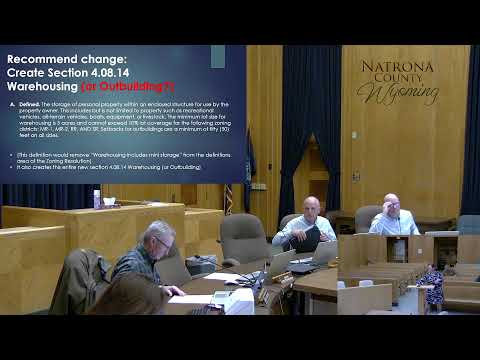
The Natrona County Planning Commission voted Thursday to approve a staff-recommended zoning text amendment that creates a new definition for “outbuildings,” removes the word “warehousing” from one section of the code, and restores wholesale distribution and storage to a separate subsection.
The change—labeled TA 26-01 on the agenda—adds section 4.08.15 for wholesale distribution and storage and creates a new outbuilding definition in 4.08.14, while keeping the existing language for wholesale distribution/warehouse and storage intact, Development Director Sabrina Kemper told the commission. “This is a requested text amendment by the planning department to remove the term warehousing from the wholesale distribution warehousing and storage section in 4.08.14,” Kemper said during her staff presentation.
Why it matters: commissioners said the rewrite is intended to distinguish small, personal accessory buildings (barns, workshops, livestock shelters) from commercial warehousing and mini‑storage. The amendment sets a five‑acre minimum lot size for the outbuilding use in many districts, limits lot coverage to no more than 10 percent in MR1, MR2, RR and SR zones, and establishes 50‑foot setbacks on all sides for the new category. The commission also agreed to change the RR entry from a zone certificate to a conditional use in order to give neighboring property owners a public hearing opportunity when lot sizes fall below the five‑acre threshold.
Building-code limits and neighbor concerns: commissioners raised questions about building heights and potential effects on neighbors if a parcel owner without a residence sought to build a large outbuilding. Brad Morrison, Natrona County building official, explained that height and related requirements are primarily governed by the building codes rather than the zoning text. “The International Residential Code scope only covers one‑ and two‑family dwellings no bigger than three‑level three‑stories,” Morrison said, adding that the International Building Code governs larger structures and sets life‑safety and fire‑safety triggers (for example, sprinkler requirements) rather than a single county height cap. Morrison noted those safety triggers and practical constraints—such as water supply for sprinklers—are part of why tall, multi‑story commercial structures are uncommon in unincorporated areas.
Process and timing: Kemper said conditional‑use permits (CUPs) require a pre‑application conference, interagency review and at least one public hearing at the planning commission before the matter proceeds to the Board of County Commissioners, a process that typically takes about three to four months when there are no complications. She read the seven approval criteria for CUPs, which include avoiding substantial strain on county services, preventing unmitigated traffic or environmental problems, and ensuring substantial conformance with the land‑use plan and other county standards.
What the commission decided: after discussion, a commissioner moved to approve the staff‑recommended changes as presented. The motion received a second and passed on a voice vote. The public hearing received no speakers; commissioners had no further public comment. The planning commission’s approval is advisory and will be forwarded to the Natrona County Commissioners, who will hold their own public hearing and make a final determination.
Next steps: staff said three cases are on the agenda for the commission’s May meeting, set for May 12.
(At the meeting, staff and commissioners used the term “Trona County” in a few places; the correct jurisdiction name is Natrona County.)