Get Full Government Meeting Transcripts, Videos, & Alerts Forever!
Get email alerts on the Public Safety topic
No spam. Unsubscribe anytime.
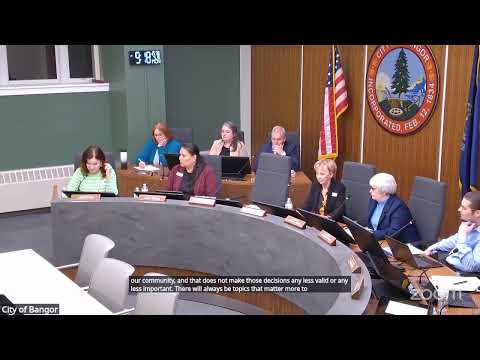
Bangor residents debate sidewalk-obstruction ordinance; council refers measure to racial-equity committee
Summary
After hours of testimony both for and against amending sidewalk rules to require licenses for any sidewalk occupation, the council voted 6-3 to refer ordinance 26-137 to the Advisory Committee on Racial Equity, Inclusion and Human Rights for further work and clarification.
The Bangor City Council on April 13 heard an extended public-record debate over ordinance 26-137, which would remove the phrase "for construction purposes" from the city's sidewalk code so a license would be required to occupy, block or obstruct sidewalks or esplanades for any purpose.
Councilor Fish read the amendment in first reading and described it as clarifying enforcement authority for police and code enforcement to ensure pedestrian safety. "The goal of this modest ordinance is to ensure that pedestrians are able to safely use the city sidewalks for walking without having to step into the street," the councilor said.
Residents, nonprofit representatives and business advocates diverged sharply. Supporters, including Ben Treat, director of the Bangor Public Library, and representatives of the Downtown Bangor Partnership, said sidewalk access is a daily accessibility and safety issue for families, seniors and visitors. "For regular users of downtown, this is not an optical experience. It is an experiential experience," said Betsy Lundy of the Downtown Bangor Partnership.
Opponents said the change was too broad and risked criminalizing people who are unhoused or who store belongings temporarily. Scott Pardee, who earlier testified about homelessness and budget impacts, called the measure "a solution in search of a problem" and said snow clearance and parked cars more often block sidewalks.
Speakers raised practical gaps: who would safeguard personal property seized or impounded under the ordinance, how temporary versus prolonged obstructions would be defined, and whether permitting requirements would unintentionally restrict small protests or private activities. Councilor Beck and others urged starting from scratch and involving advisory committees to draft enforceable, fair policies that include a "tag-and-hold" reunification process for property and clear definitions of prohibited conduct.
After public comment and council discussion about procedure (several members noted the ordinance had already passed GovOps committee 4-1), the council voted 6-3 to refer 26-137 to the Advisory Committee on Racial Equity, Inclusion and Human Rights (ACRE) for review and recommendation. Votes in favor emphasized safety and accessibility; votes against said the draft was legally vulnerable and too vague.
Next steps: the ordinance will be reviewed by ACRE and may return to the council with proposed language addressing enforcement, property-handling procedures, definitions, and constitutional concerns.